Vincent

The Vincent family appears to have moved to Lancaster County in the 1790’s, possibly from North Carolina. There were no Vincents (under any spelling) listed in the 1790 census in South Carolina. But in 1800, there was a Drury Vincent living in Lancaster District.1 Drury is mentioned in two deeds, one where he bought six acres in 1800,2 and another from 1804 where he sold the six acres.3 In the 1804 deed it describes him as living in Mecklenburg County, North Carolina. It does not appear that he continued to have connections to Lancaster District afterwards. Rather, the Vincent family of Lancaster District appear to all descend from Peter Vincent who is mentioned in a deed from 1807. The deed begins “Whereas Peter Vincent late of the District & State aforesaid was in his life time and at the time of his Death seized & possessed in fee simple of the following Plantation, being on the North side of the Catawba River adjoining lands of Andrew Pickens, William Davis & William Hood…And whereas the said Peter Vincent departed this life intestate leaving Ann Vincent Edmund Vincent, Henry Vincent Peter Vincent Thomas Vincent William Vincent Rebecca Vincent and Edmund Williamson heirs at Law.”4 Thomas had petitioned for a division of the land. This had resulted instead in a public sale of the land after a third had been marked off for “Ann Vincent the widow.” Thomas bought the land at the sale in April 1807. Besides Ann Vincent the widow, the others listed are presumably children and a son-in-law Edmund Williamson. Peter, Jr.,5 Edmond (Edmund),6 and Henry7 are the only Vincents listed in Lancaster District in 1810. It’s not clear what happened to Thomas and William. If they were not accidentally skipped over, they must have been deceased or had moved away. Peter, Jr. moved to Kershaw District8 and then later to Lowndes County, Alabama9 where he lived the rest of his life. However, it would seem that Thomas and William were still living in 1812 when a Thomas Vincent witnessed a deed between Peter P. Vincent and William Vincent.10 Henry Vincent witnessed the deed. It’s possible some of these were grandchildren rather then the sons. Thomas and his wife Mary sold some land to Benjamin Massey in 1810.11 It would seem then that Thomas should have been listed on the 1810 census in Lancaster District and was accidentally skipped or was not a head of household himself at the time. There was a William Vincent who, along with his wife Sarah, sold some land to Thomas Cureton in 1818.12 It’s not clear that these deeds all concern the sons of Peter Vincent. Peter Jr. appears to have been born in the 1760’s or 1770’s per the census records, so it’s possible Peter P., and William and Thomas mentioned in these deeds could have been grandchildren of the earliest Peter whom the 1807 deed references.

Willis K. Vincent

Our Vincent ancestor appears to be Willis K. Vincent. Some family histories report his middle name as Kermit, but this is unproven. He was likely a grandson of the elder Peter Vincent since he was born about 1795 in South Carolina according to the 1850 census, which lists him as W. K. Vinson.13 In the household are M. E. (f) age 21, M. A. (f) age 19, W. H. (m) age 18, S. C. (f) age 8, and F. (f) age 1. He had previously been listed in the census beginning in 1820 as Willis and Willis K. Vincent.14,15,16 He is listed in the 16-25 age category in 1820 which barely fits with the later age estimate in 1850. The only other person in his household is a woman age 45 and upwards who could potentially be his mother. By 1830, it appears he had married as there is additionally a woman in his own age category in the household along with a girl age 5-10, two girls under five, and one boy under five. The older woman is still with him. He is listed next to James Ingram on that census. In 1840, the older woman is no longer with them, but his apparent wife is listed in the 50-60 category while he is listed in the 40-50 category. With them are a girl age 15-20, one age 10-15, and two age 5-10. Additionally there are two boys, one age 15-20, the other 5-10. It would appear the youngest boy is the W. H. Vincent who appears on the 1850 census while two of the girls would be the M. E. and M. A. Vincent. It would appear that his wife had died by 1850, perhaps within a year since there is a female with initial F. age one with him. It’s also possible the youngest was a grandchild.

Willis first bought land in 1834 when he purchased 66 acres from Rachel Miller.17 In 1843, he bought 44 acres of land from James Cauthen lying on headwaters of Little Lynches Creek alongside of land he already owned.18 Finally in 1852, he bought 35 3/4 acres from John F. Horton and Mary J. Williams of Alabama lying on waters of Lick Creek, known as the Samuel Ussery land.19 This was bounded by lands of Thomas Cauthen, James Truesdale and the estate of Evan Horton.

A report to the South Carolina Senate in December 1839 on recommendations for payments to various county officials by county lists Willis K. Vincent as a constable under Lancaster District, to be paid $5.02.20

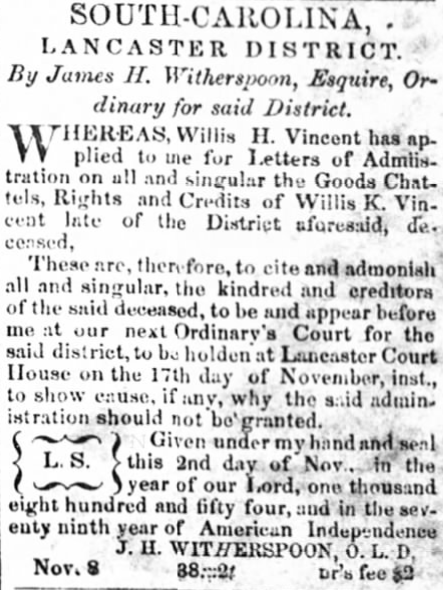
Willis Vincent had died by late 1854 when it was announced in the newspaper that Willis H. Vincent had applied for letters of administration on his estate.

The Lancaster News, 22 Nov 1854

William H. Vincent

Although the census lists him as W. H. Vincent and he is erroneously called Willis H. Vincent in the announcement above, he consistently appears as William Vincent in later records. His middle name is believed to be Henry, but this is again unproven. There is no other William or Willis Vincent in Lancaster District. He is listed as Wm. Vinson on the 1860 census, living in the same general area as is father had.21 These later census records put his birth around 1829 which is a couple years off from the earlier census records which indicate he was probably born around 1832. In 1860, his wife is listed as Missouri and he had a three year old son named John. The family continues to be listed through 1900 .22,23,24 In addition to John, the census indicates they had children Mary (b. c1860), William Francis (b. c1864), Elizabeth (b. c1867), and Minor (b. c1870). In 1900, William and Missouri are living in their son William’s household.

Daughter Elizabeth was married to W. H. Mahaffey. Her death certificate,25 along with the death certificates of John S. Vincent26 and Minor Vincent27 state their parents names as William Vincent and Missouri Sims.

His son William F. Vincent committed suicide in 1914.28 The Lancaster News reported that he had been working on the plantation of Mr. J. J. Blackmon and the family was planning to move to work at the Kershaw mill that day when he was found in Mr. Blackmon’s field. It states that he was a son of the late William Vincent.

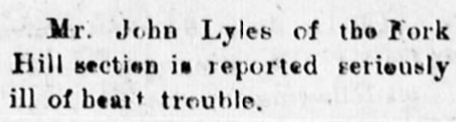
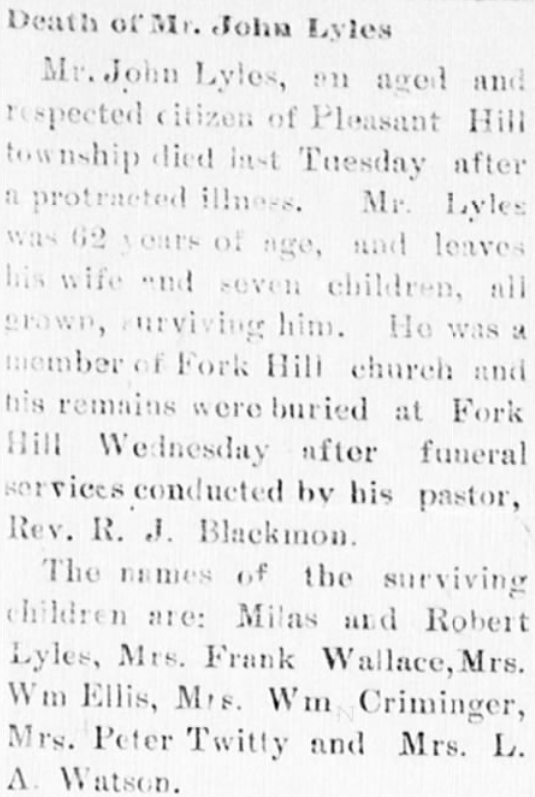
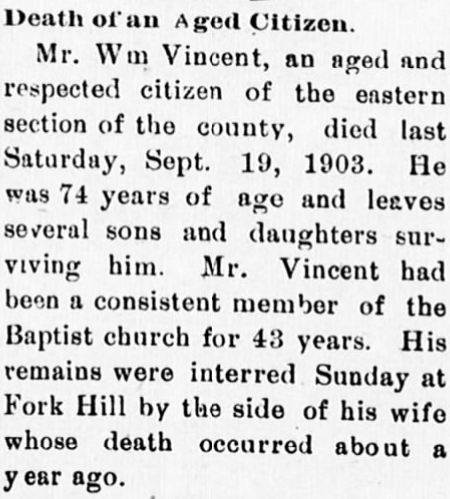
His wife Missouri died in 1902 and William himself died on 19 Sep 1903. They were both buried in the Fork Hill Baptist Church Cemetery, although the graves are unmarked.

The Lancaster News, 23 Sep 1903

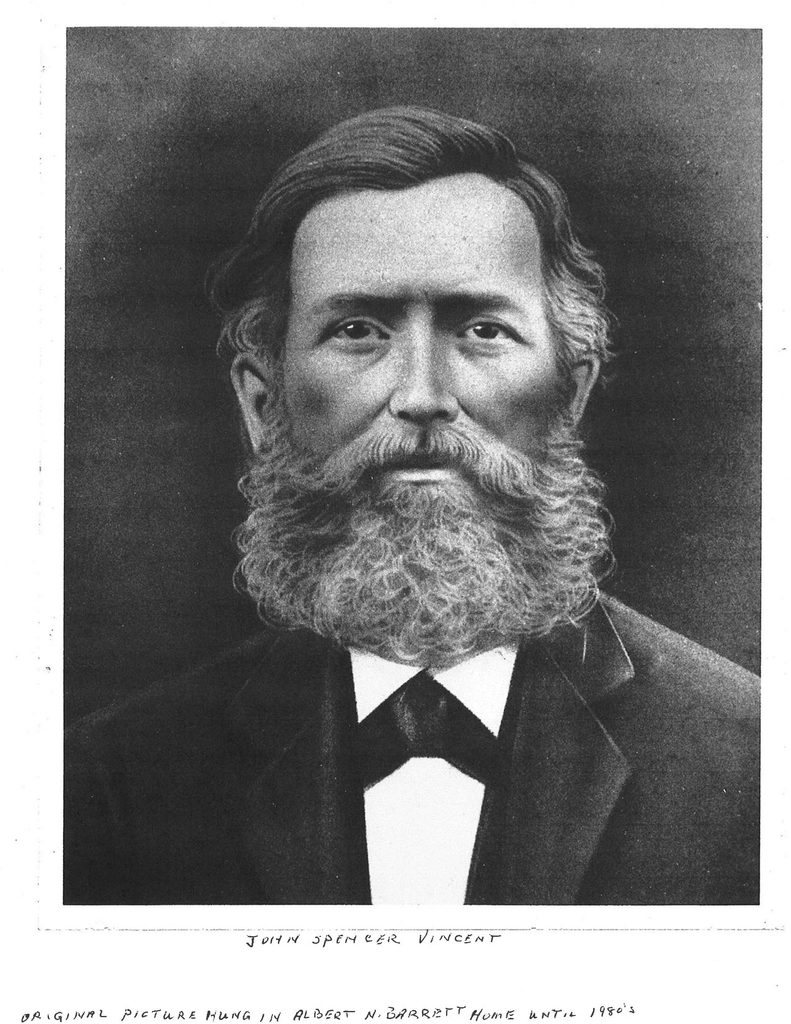
John Spencer Vincent

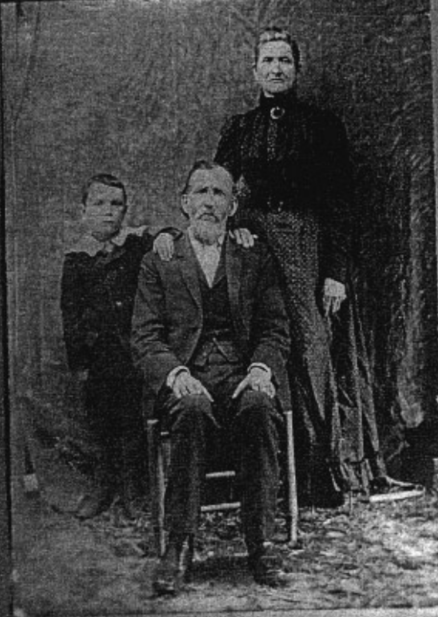
John’s death certificate, already mentioned, states that he was born 22 Feb 1856. However, the 1900 census states Sep 185629 and his headstone states 22 Sep 1856. None of the records found so far give the middle names for either John or his wife, but these have been recorded in association with family photos by previous generations.

John was married to Martha Drucilla Blackmon around 1873 and they had three children, Della, Mary Jane, and John William. John was a farmer.

Fork Hill Baptist Church minutes show that Martha D. Vincent and her daughters Della Hinson and Mary J. Vincent were church members by a roll taken 14 Jul 1895.30 Later, the minutes state: “The Rev. A. M. Croxton preached a series of sermons for us at Fork Hill commencing August 7, 1897 closing August 13th. He preached with great power & demonstration. The spirit was so apparent that none could doubt. And there were 46 souls added to the church. (Of these forty presented them selves as candidates for baptism as follows:” John Vincent was among those forty listed.

John and his wife Martha were buried at Fork Hill Baptist Church Cemetery, although the headstone is very difficult to read.31

Mary Jane Vincent

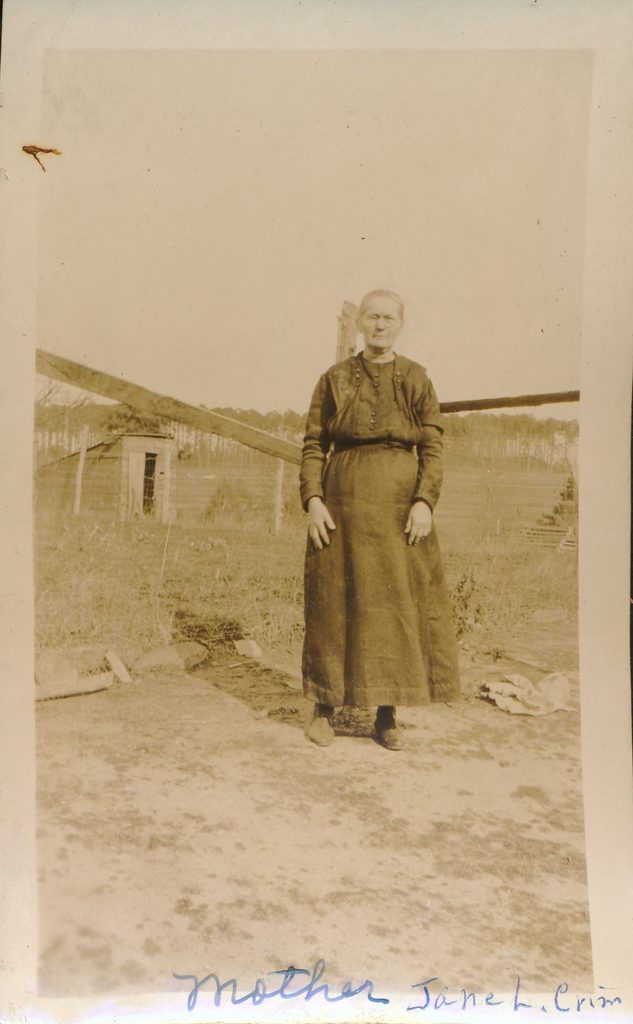
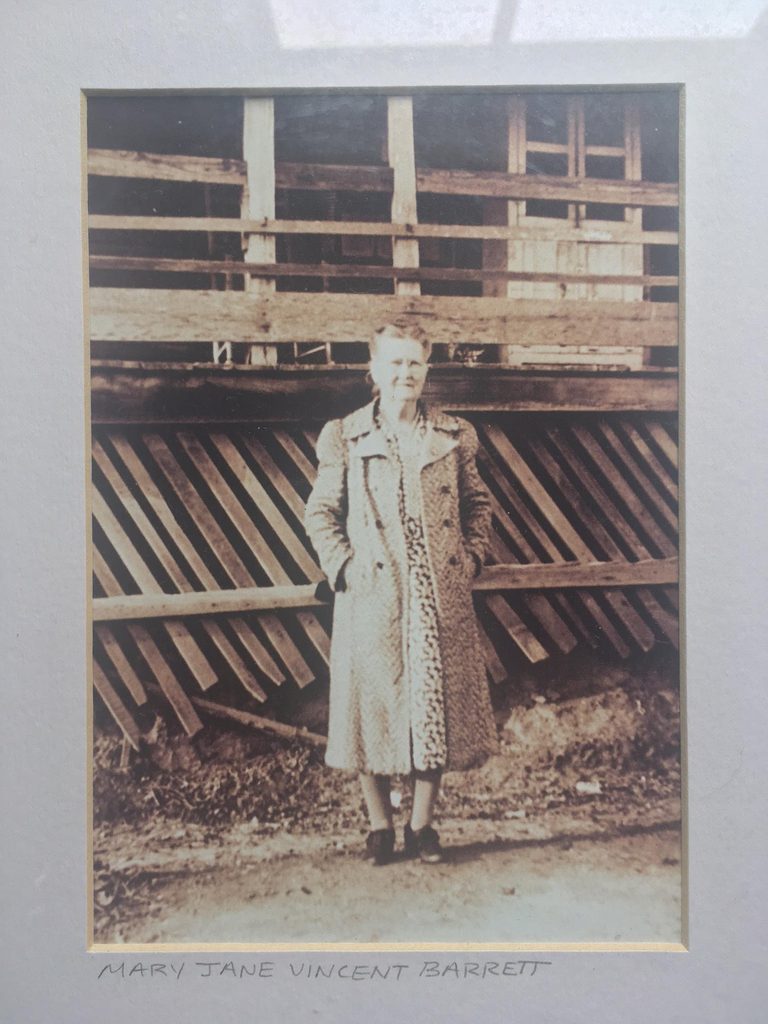
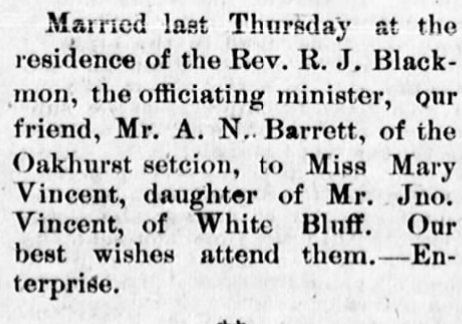
Grandma Barrett was born 17 Dec 1877.32 She was married to Albert Newton Barrett in 1901. She was his second wife, Laura Crimminger Barrett having died in 1900.

The Lancaster News, 27 Jul 1901

Together, Albert and Mary Jane had nine children. The first, a daughter named Martha, died as an infant in 1902. The family lived in a house along Barrett Road in Heath Springs that Albert had built in 1898.

A grandson, William Barrett, remembered: “Grandma was a quite a lady. She was a great cook, sewed a lot, kept the house, had a great flower garden, was always there taking care of things. Once when I was there Grandma figured out that I needed a spring ‘clean out.’ This consisted of a big dose of Edson Salts followed by a cup of warm coffee. I did not finish the coffee and barely made it up the hill to the outhouse. I never complained about feeling bad again.”33

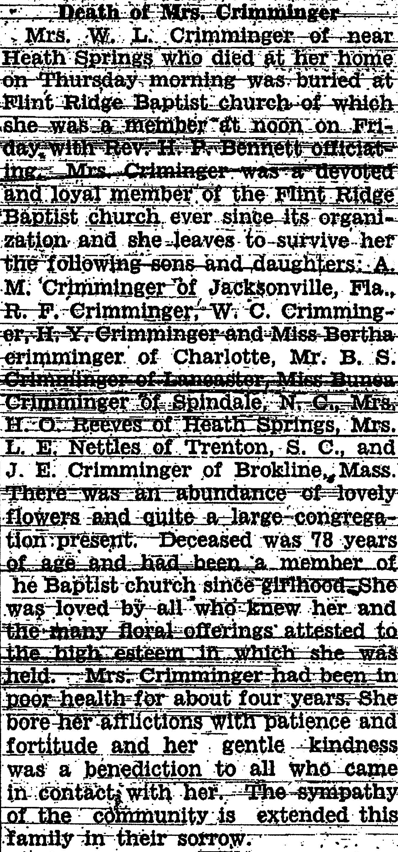
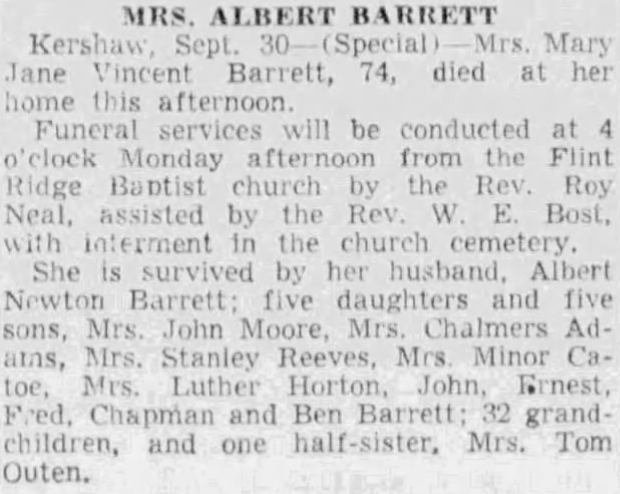
Grandma Barrett passed away in 1951 and was buried in the Flint Ridge Baptist Church Cemetery.34

The State, 1 Oct 1951

  1. “United States, Census, 1800”, FamilySearch (https://www.familysearch.org/ark:/61903/1:1:XHRH-BG5 : Fri Aug 21 13:50:12 UTC 2026), Entry for Drury Vincent, 1800. ↩︎
  2. Lancaster County, South Carolina Deed Book G, p241, FamilySearch (https://www.familysearch.org/ark:/61903/3:1:3Q9M-CSLV-PQW9-V) ↩︎
  3. Lancaster County, South Carolina Deed Book G, p245, FamilySearch (https://www.familysearch.org/ark:/61903/3:1:3Q9M-CSLV-PQ4W-5) ↩︎
  4. Lancaster County, South Carolina Deed Book G, p58, FamilySearch (https://www.familysearch.org/ark:/61903/3:1:3Q9M-CSLV-PQ4Q-5) ↩︎
  5. “United States, Census, 1810”, FamilySearch (https://www.familysearch.org/ark:/61903/1:1:XH2Y-M4T : Sat Mar 09 03:37:12 UTC 2024), Entry for Peter Vincent, 1810. ↩︎
  6. “United States, Census, 1810”, FamilySearch (https://www.familysearch.org/ark:/61903/1:1:XH2Y-MNS : Sat Mar 09 14:19:42 UTC 2024), Entry for Edmond Vincent, 1810. ↩︎
  7. “United States, Census, 1810”, FamilySearch (https://www.familysearch.org/ark:/61903/1:1:XH2Y-MV3 : Sat Mar 09 17:26:36 UTC 2024), Entry for Henry Vincent, 1810. ↩︎
  8. “United States, Census, 1830”, FamilySearch (https://www.familysearch.org/ark:/61903/1:1:XHPK-BP9 : Fri Mar 08 11:55:41 UTC 2024), Entry for Peter Vncent, 1830. ↩︎
  9. “United States, Census, 1840”, FamilySearch (https://www.familysearch.org/ark:/61903/1:1:XHTL-4HJ : Sun Mar 10 22:22:06 UTC 2024), Entry for Peter Vincent, 1840. ↩︎
  10. Lancaster County, South Carolina Deed Book H, p26, FamilySearch (https://www.familysearch.org/ark:/61903/3:1:3Q9M-CSLV-PQ7R-5) ↩︎
  11. Lancaster County, South Carolina Deed Book H, p120, FamilySearch (https://www.familysearch.org/ark:/61903/3:1:3Q9M-CSLV-PQ7C-Y) ↩︎
  12. Lancaster County, South Carolina Deed Book I, p125, FamilySearch (https://www.familysearch.org/ark:/61903/3:1:3Q9M-CSLV-599K) ↩︎
  13. “United States, Census, 1850”, FamilySearch (https://www.familysearch.org/ark:/61903/1:1:M8QJ-HDR : Tue Oct 21 13:41:36 UTC 2025), Entry for W K Vinson and M E Vinson, 1850. ↩︎
  14. “United States, Census, 1820”, FamilySearch (https://www.familysearch.org/ark:/61903/1:1:XHL7-7PJ : Sun Jan 19 05:28:13 UTC 2025), Entry for Willis Vincent, 1820. ↩︎
  15. “United States, Census, 1830”, FamilySearch (https://www.familysearch.org/ark:/61903/1:1:XHGY-7NL : Sat Mar 09 14:41:21 UTC 2024), Entry for Willis Vincent, 1830. ↩︎
  16. “United States, Census, 1840”, FamilySearch (https://www.familysearch.org/ark:/61903/1:1:XHYL-CBC : Thu Mar 07 11:33:42 UTC 2024), Entry for Willis K Vincent, 1840. ↩︎
  17. Lancaster County, South Carolina Deed Book M, p523, FamilySearch (https://www.familysearch.org/ark:/61903/3:1:3Q9M-CSR8-F3XV-6) ↩︎
  18. Lancaster County, South Carolina Deed Book O, p317, FamilySearch (https://www.familysearch.org/ark:/61903/3:1:3Q9M-CSR8-NS6T-1) ↩︎
  19. Lancaster County, South Carolina Deed Book Q, p357, FamilySearch (https://www.familysearch.org/ark:/61903/3:1:3Q9M-CSLK-VP8) ↩︎
  20. Report of the Comptroller General, to the Legislature of South Carolina, November 1839, p46 ↩︎
  21. “United States, Census, 1860”, FamilySearch (https://www.familysearch.org/ark:/61903/1:1:MZT8-XTZ : Mon Jul 08 22:37:43 UTC 2024), Entry for Wm Vinson and Misouri Vinson, 1860. ↩︎
  22. “United States, Census, 1870”, FamilySearch (https://www.familysearch.org/ark:/61903/1:1:M8RK-L9F : Mon Oct 20 21:56:34 UTC 2025), Entry for Elizabeth Vincent and William Vincent, 1870. ↩︎
  23. “United States, Census, 1880”, FamilySearch (https://www.familysearch.org/ark:/61903/1:1:M6SJ-DH3 : Mon Jan 20 03:38:48 UTC 2025), Entry for William Vincent and Missourie Vincent, 1880. ↩︎
  24. “United States, Census, 1900”, FamilySearch (https://www.familysearch.org/ark:/61903/1:1:M3T7-KCK : Wed May 14 07:06:52 UTC 2025), Entry for William Vincent and Nannie Vincent, 1900. ↩︎
  25. “South Carolina Deaths, 1915-1973”, FamilySearch (https://www.familysearch.org/ark:/61903/1:1:N96R-JLH : Mon May 06 19:34:21 UTC 2024), Entry for Elizabeth V. Mahaffey and William Vincent, 1942. ↩︎
  26. “South Carolina Deaths, 1915-1973”, FamilySearch (https://www.familysearch.org/ark:/61903/1:1:N9DC-N4C : Mon May 06 18:40:35 UTC 2024), Entry for John S. Vincent and William Vincent, 28 Mar 1926. ↩︎
  27. “South Carolina Deaths, 1915-1973”, FamilySearch (https://www.familysearch.org/ark:/61903/1:1:N9X7-85C : Mon May 06 18:25:21 UTC 2024), Entry for Minor Vincent and Wm Vincent, 8 Oct 1915. ↩︎
  28. The Lancaster News, Apr 21, 1914, “Mr. W. F. Vincent Shoots Himself” ↩︎
  29. “United States, Census, 1900”, FamilySearch (https://www.familysearch.org/ark:/61903/1:1:M3T7-J83 : Wed May 14 07:24:03 UTC 2025), Entry for John Vincent and Martha Vincent, 1900. ↩︎
  30. Floyd, Viola Caston. Abstracts of Fork Hill Baptist Church Minute Book 1881-1916 ↩︎
  31. Find a Grave, database and images (https://www.findagrave.com/memorial/50339923/john_spencer-vincent: accessed 21 Aug 2026), memorial page for John Spencer Vincent (22 Sep 1856–28 Mar 1926), Find a Grave Memorial ID 50339923, citing Fork Hill Cemetery, Fork Hill Crossroads, Lancaster County, South Carolina, USA; Maintained by Catoe4 (contributor 47413036). ↩︎
  32. “South Carolina Deaths, 1915-1973”, FamilySearch (https://www.familysearch.org/ark:/61903/1:1:FPMQ-XC2 : Mon May 06 19:13:36 UTC 2024), Entry for Mary Jane Vincent Barrett and John William Vincent, 1951. ↩︎
  33. Barrett, William Alexander. (2005) Our Barrett Family History, p35 ↩︎
  34. Find a Grave, database and images (https://www.findagrave.com/memorial/50064252/mary_jane-barrett: accessed 21 Aug 2026), memorial page for Mary Jane Vincent Barrett (17 Dec 1877–30 Sep 1951), Find a Grave Memorial ID 50064252, citing Flint Ridge Baptist Church Cemetery, Heath Springs, Lancaster County, South Carolina, USA; Maintained by Catoe4 (contributor 47413036). ↩︎

Mullens

The Mullens family (variously spelled as Mullyns, Mullins, Mollins, etc) lived in London in the late 1500’s. The earliest this family has been traced is to John Mullens, surgeon, of London.

John Mullens

John Mullens was married to Anne Hunte on 4 Jun 1583 at St. Stephen’s, Coleman Street in London.1

Records of baptism for several of their children have been found in the St. Stephen’s, Coleman Street Parish Register:2

  • Christenyng of Susan Mollyns the daughter of John Mullens the xviiith of September (1587)
  • Mary Mullens daughter to John Mullens the viith of December (1589)
  • Thomas Mullins sonne to John Mullins baptized ye xiiiith of February (1590/1)

A record for the baptism of his son James has not been found. It appears that Susan and Thomas probably died young as they are not mentioned later.

John left a nuncupative will dated 18 Aug 1603 and proved 29 Aug 1603 in which he mentions his daughter Marie Mullens and son James Mullens.3 He describes himself as chirurgeon of London, an archaic term for a surgeon. Present during the giving of the will were friends William and Hester Knowles, Thomas Tennaunt, Barbara Mullens and others. The mention of the Knowles is significant in identifying his son James and one of James’s daughters was married to a Knowles.

Ann had died just previously to John in March of 1603 and was buried 5 Mar 1602/3 at St. Stephen, Coleman Street.4 A son named John was was buried there the 3rd of August that same year. Finally, John himself was buried there on the 20th of August.

James Mullens

James’s will helps identify him and provide connections to the rest of his family. He wrote his will on 28 Nov 1638.5 He styled himself citizen and barber surgeon of London and commended himself to God “believing by and thorough the alone merrittes and satisfaccon of my Lord and Saviour Jesus Christ to have free remission of all my synnes heere and everlasting life hereafter.” He mentioned his wife Aurelia to whom he gave his property in St. Andrew parish in Holborn, London. He mentioned a bunch of other property in the area including at Shoelane, a street in Holborn, occupied by various tenants to his eldest son James and other sons Edward, John, William, Matthias, and Charles. He mentioned his grandson James, eldest son of Edward. Later he mentioned “my three daughters Lucy Knolles wife of Thomas Knolles Dora Aurora Pepper wife of Richard Pepper and Aurelia Coxe wife of William Coxe” who received sums of money. He then named more grandchildren: Lucy Knolles, Aurelia Knolles, Thomas Knolles, and John Knolles; Aurelia Pepper, Elizabeth Pepper, Jane Pepper and John Pepper; Jane Molins daughter of James Molins. Finally, he mentioned his sister Marie Pilkington(?). He gave five pounds to the Maister and Wardens of the Mistery & Commonality of the Barbers and Suregons of London to be distributed among the poor of that company. He also gave twenty pounds “for and towards the fynishing of the theater att Barbor Surgeons hall London.” He also gave five pounds to the poor of the parish of St. Andrew, Holborn.

A marriage record for James and Aurelia has not been found, but she is identified as the daughter of the famous John Florio in his will which mentions “my daughter Aurelia Molins” and later “my sonne in law James Molins.”6

Baptisms for many of his children have been found in the records of St. Andrew, Holborn:7

  • James the sonne of James Mullens bapt the same daie (3 Apr 1605)
  • Fredericus Mullins the sonne of James Mullins bapt the same daie (9 Nov 1606)
  • Dorothy the daughter of Jeames Mullens bapt the xxv of October (1607)
  • Theophilus the sonne of James Mullins bapt the iiith of Mch (1608/9)
  • Deraurora or Theraorora the daugh of Mr Mullens barb Shoe Lane bapt xxvith (Aug 1612)
  • John sonne of James Mullens barbchirurgion in Shoe Lane bapt the xxith (May 1615)
  • Willm Mullins the sonn of James Mullins Barber Sur & Aurelia his wife in Shoe Lane bap the 27th February (1616/7)
  • Mary Mullins Daugh of James Mullins barber Surgion & Aurely his wife in Shoe Lane was bap the 15 (Feb 1617/8)
  • Aurelia Mullins Daughter of James Mullins Barber Surgion & Aurelia his wife out of Shoe Lane was baptised the 21 of Aprill 1619
  • Margaret Mullins Daughter of James Mullins barber surgion and of Aurelya his wife in Shoolane was bap the 28 (Sep 1620)
  • Matthias Mullins sone of James Molins Suyurgion & of Aurelia his wife in Shoe Lane was baptised the 3d of May 1622

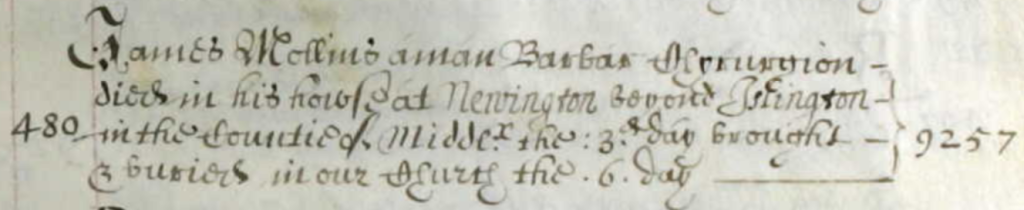
The burial record for James states that he died 3 Dec 1638 at his house at Newington, Middlesex and was buried at St. Andrews, Holborn in London on the 6th.8

His wife outlived him, writing her own will on 7 Feb 1640/1. She described herself as “Aurelia Molins widowe late wife of James Molins tholder cittizen & Barber Chirurgion of London deceased.” She named her children including “my daughter Aurelia Cox the wife of William Cox” to whom she gave five pounds.9

Aurelia Mullens

Aurelia was baptized on 21 Apr 1619. She was married to William Cox on 23 Jun 1635 at St. Mary, Stoke Newington, Middlesex County.10 They had six children. Aurelia died and was buried at St. Andrew, Holborn in London on 21 Jan 1654.11


  1. St. Stephen’s, Coleman Street, Middlesex Parish Register 1538-1598, London Metropolitan Archives, P69/STE1/A/001/MS04448 ↩︎
  2. St. Stephen’s, Coleman Street, Middlesex Parish Register 1598-1636, London Metropolitan Archives, P69/STE1/A/002/MS04449/001 ↩︎
  3. Prerogative Court of Canterbury Piece 102 (Bolein), folio 55 reverse ↩︎
  4. St. Stephen’s, Coleman Street, Middlesex Parish Register 1598-1636, London Metropolitan Archives, P69/STE1/A/002/MS04449/001 ↩︎
  5. Prerogative Court of Canterbury Piece 178 (Lee), folio 478 reverse ↩︎
  6. Prerogative Court of Canterbury Piece149 (Hele), folio 330 reverse ↩︎
  7. St. Andrew, Holborn, Middlesex Parish Register 1558-1623, London Metropolitan Archives, P82/AND/A/001/MS06667/001 ↩︎
  8. St. Andrew, Holborn, Middlesex Parish Register 1623-1642, London Metropolitan Archives, P69/AND2/A/010/MS06673/002 ↩︎
  9. London Metropolitan Archives, MS 9052/10; Will Number: 212 ↩︎
  10. Saint Mary, Stoke Newington, Middlesex Parish Register 1560-1812, London Metropolitan Archives, P94/MRY/001 ↩︎
  11. Saint Andrew, Holborn, Middlesex Parish Register 1653-1672, London Metropolitan Archives, P69/AND2/A/010/MS06673/004 ↩︎

Hicklin

The Hicklin family is believed to have come from Tyrone, Ireland in the mid 1700’s and later ended up in Lancaster County, South Carolina. There don’t appear to be many original records available on this family to connect them, so interaction with family tradition is necessary. The available records can serve to supplement and correct what has been handed down. There is a document compiled and certified by a notary public in 1931 which gives a history of the family by J. C. Hicklin, a copy of which is found in the files of the Fairfield Genealogy Society of Fairfield County, South Carolina.1 The first page of this document is a short summary of the history of the Hicklin family which states it was a record taken in 1870. It is reproduced here.

(From a sketch by J. C. Hicklin, son of Zachariah and Sarah Cloud Hicklin, and grandson of William Hicklin.)

Arthur Hicklin, from Tyrone, Ireland settled in Pa. —, thence to Lancaster County, S. C., between 1750 and 1761 - He was buried in the Hicklin grave-yard, now owned by Daniel Brown, about one mile from Brown's Ferry. He had five sons, VIZ: George, William, Arthur, Hugh and John. They served in the Revolutionary War. Arthur and John ware killed in the battle of Hanging Rock.

William was born in 1734 in Ireland, Died Oct. 10, 1819, aged 85 years - Sarah Isbel, wife of William Hicklin, died July 29, 1841. She lived to about 93 years old. The Sons of William and Sarah Isbel Hicklin were:
Jason, Hugh, Zachariah, William Arthur and Reubin.

NOT: This record was taken in 1870, from Hugh, the son of Zachariah and Sarah Cloud Hicklin, and their family record.
October 1870

Signed
J. C. Hicklin
Chester County, South Carolina 

The second page which includes the certification statement from 1931 begins another section by L. M. Ford who married Jane Atwood Hicklin. This includes details which connect this family all the way down to the Cole family from which we descend.

This family is of Scotch origin. On account of persecutions received in Scotland, Arthur Hicklin left his home (Native land) and settled in Tyrone, Ireland, probably about 1730. After a residence here of more than 20 years the times were again stormy, so much so that he concluded to go to America where he might serve God in his own way, under his own vine and fig tree. Sometime in the decade of 1750-1760 which nearly desecrated Ireland, Arthur Hicklin brought his family over, and settled in Lancaster, Pa. It is not thought that he tarried long at this place. He came to South Carolina and settled in Lancaster County, taking up a large body along the eastern bank of the Catawba River at Browns Ferry.

The name of Arthur Hicklin's wife is not known. It is likely that he was married before he left Scotland. His children were: George, William, Arthur, Hugh, John and Elizabeth.

Some years of peace were spent in the forest, but "dogs of war" were turned loose, and the Revolution was on hard. Having some experience in the treatment by the Royal Government, the sons of Arthur Hicklin, one and all, soon decided on which side they would serve. So the Whigs were strengthened by the five sons of Arthur Hicklin. Arthur Jr., Hugh and John lost their lives in battling for their country. One fell at Hanging Rock, another at Eutaw Springs, and still another was so badly wounded in the latter battle, that he died. Arthur, Jr., left two daughters who were reared by their Uncle George Hicklin (his brother). One daughter married Henry Cole. The other daughter married a Williams. A daughter of Henry Cole, married Capt. Nathaniel Vanlandingham of Lancaster County, and left children. He was an ardent Methodist, and is said to have been the first Class leader in the up country.

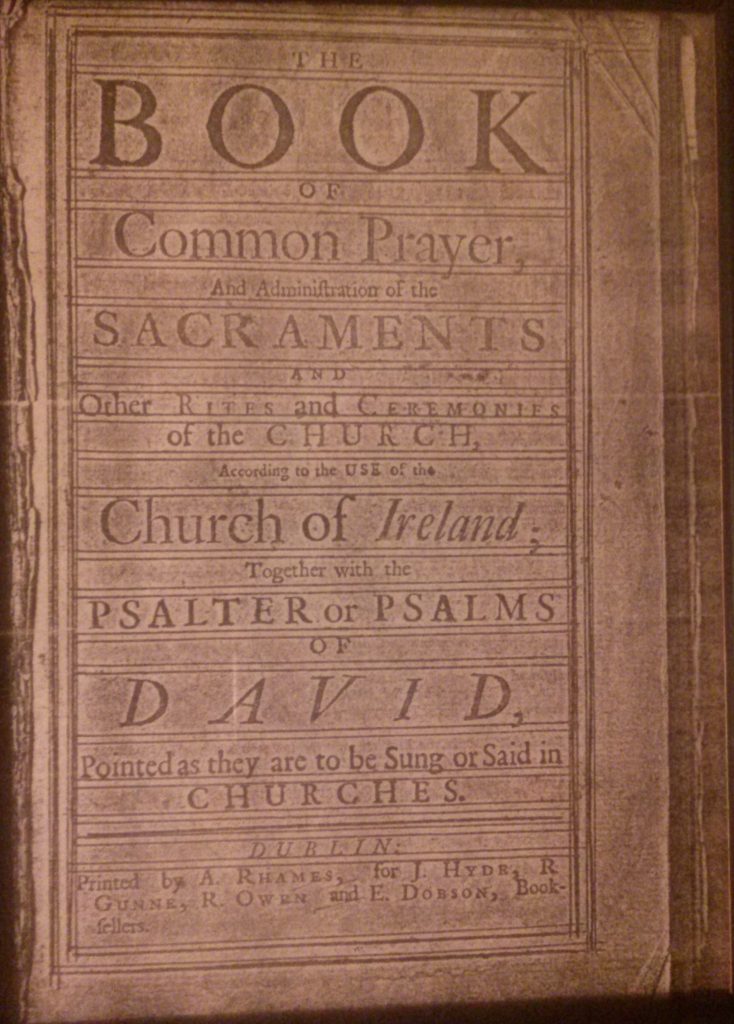
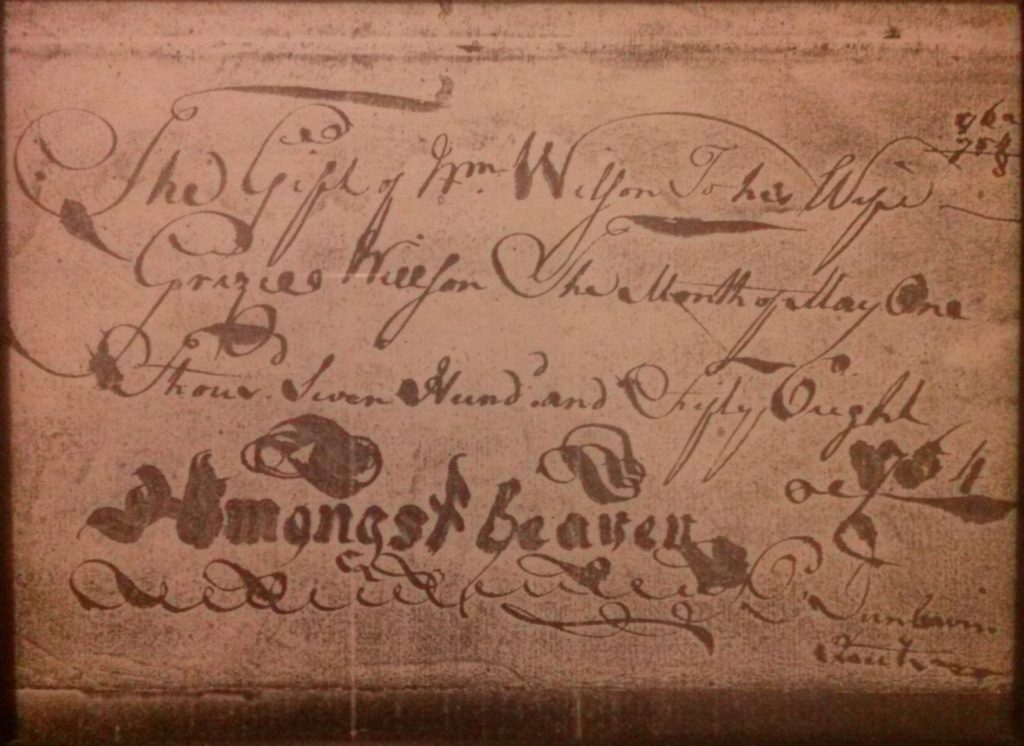
His Bible and a hymn bock are still preserved among the decendants of Henry Cole.

While not every detail of this can be proven, some further details from other records will be discussed for these individuals in our line.

Arthur Hicklin

Arthur Hicklin Sr. and Arthur Hicklin Jr. received grants for land in Craven County, South Carolina the same day, 23 Oct 1765. Arthur Sr.’s land was 150 acres on a branch of Rocky Creek.2 Arthur Jr. got 100 acres bounded by other land, some of it already owned.3 Memorials for these pieces of land were recorded together.4 William Hicklin also received 100 acres the same date.

Arthur Hicklin lived in Lancaster County. In a 1787 deed, he gave fifty acres including “all the former improvements viz. houses buildings orchards cleared land &c whereon I the said Arthur Hicklin now live” to “my well beloved son John Hicklin.”5 William Hickling and Arthur Hicklin Jr. witnessed the deed. Note that this contradicts the above family history which states that John Hicklin died during the Revolutionary War.

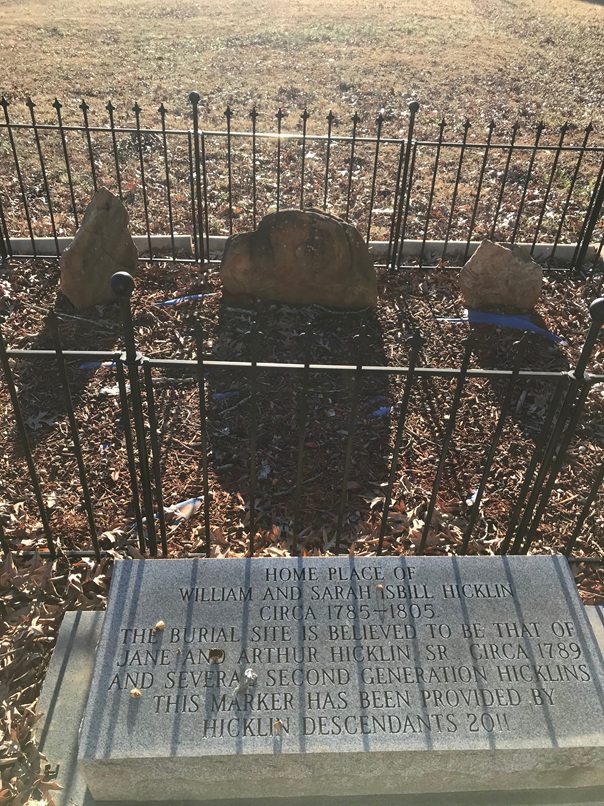
Arthur Hicklin supposedly died soon after the time of that deed and it is claimed he was buried in the Hicklin family graveyard. This land was later the place of his son William Hicklin. There is a plaque placed at the cemetery which reads: “Home Place of William and Sarah Isbill Hicklin Circa 1785-1805 The burial site is believed to be that of Jane and Arthur Hicklin Sr. circa 1789 and several second generation Hicklins – This marker has been provided by Hicklin descendants 2011.”6

Arthur Hicklin Jr. and George Hicklin

As has been mentioned already, Arthur Jr. received a grant for 100 acres in Craven County on 23 Oct 1765, the same day has his father’s grant. Not much else is known for sure of Arthur Jr. It is claimed in the Hicklin document quoted above that Arthur Jr. lost his life along with Hugh and John in the Revolutionary War and that he left two daughters who were reared by his brother George. This is in conflict with what the document claims later. Later it states that he was born 7 Mar 1758 and died 19 Nov 1799. It claims he was married to Elizabeth Williams, born 1762 and who died 1803. And it states they had children Elizabeth, wife of Henry H. Cole, and Sarah, wife of William Cain. These would be the two daughters apparently reared by their uncle George. As will be seen, this presents a confusing contradiction of ideas and has yet to be resolved.

Elizabeth Hicklin

What we do know for certain is that we descend from Elizabeth Hicklin and that she was connected in some way to the above family. The Hicklin family Bible, printed in 1793, records information on some of the Hicklin, Cole and Crain families.7 Concerning the Hicklin family it states:

  • George Hicklin was born April 27th, 1754.
  • William Hicklin was born May 8th 1780
  • George Hicklin departed this life November 15th 1824
  • Rebecca Hicklin departed this life 26th June 1829
  • William Hicklin departed this life 1841

Given how early the date is, it would seem reasonable to conclude that George Hicklin born in 1754 is the same as George, son of Arthur Sr. It would also appear that he is the same one listed here as dying in 1824. The census would seem to agree with this as there is a George, appearing to be the same individual who is listed as a head of household in Lancaster District from 1790 through 1820, but not afterwards.8,9,10,11 It must be noted however that there were two George Hicklins listed in 1790 and it is not clear which is this one. It may be possible that Rebecca was George’s wife and William was their son.

The marriage of Elizabeth Hicklin to Henry Cole is recorded in the family Bible as well:

  • Henry H. Cole was married to Elizabeth Hicklin 21st day of Decr A.D. 1815

We do not know when Elizabeth was born, but given that her husband was born in 1792 and they married in 1815, she was probably born between 1792 and 1800. It would seem odd that her birth would be left out of the Bible if she were George’s daughter. Additionally, if William was a son of George and Rebecca and was born in 1780, that would put a bit of a distance between him and Elizabeth if she were his sister.

In addition to the Cole family, the births of James Crain in 1811, Alexander Crain in 1813, and the death of Sarah Crain in 1830 are recorded. This becomes significant when paired with Lancaster County Court records.

There is an Equity court case from July 1830 entitled Sarah Cole & others, minors by their next friend vs. Alexander Creyon that yields some tantalizing, yet confusing details.12 The case opens by stating that It appears that George Hicklin had a wife but no children. George Hicklin made and duly executed his last will and testament on – day December 1823 by which he devised and bequeathed his whole estate to his wife for life, and at her death to the complainants and the defendants who were his nephews and neices. It then quotes the will “And all the balance of said estate real and personal, It is my will and desire that it be equally divided between Henry and Elizabeth Coles’s children and Alexander Creyon viz – the offspring of said Elizabeth Coles body and no other; to be retained in the hands of my executors and executrix, until the age of 21 years or days of marriage; which should first happen; then to be made over then to them lawfully each legatee receiving their just ? of the same, which I will and bequeath to them and their heirs forever.” The case then states that “George Hicklin died leaving his said last will and testament in full force and leaving alive his said wife and said sisters Elizabeth Cole and Sarah Creyon – Henry Cole the husband of Elizabeth is also alive – the complainant and their children – the eldest of them about twelve years of age – and the defendant Alexander Creyon of the age of 17 years – the widow of the testator is dead.”

This case states quite clearly that this George Hicklin who left a will dated Dec 1823 had sisters named Elizabeth Cole and Sarah Creyon (Crain). The children of Elizabeth and Sarah are the complainants and the defendants who are described as his nephews and nieces in the introduction to the case. Given that this George wrote his will in late 1823, it would seem apparent that it is the same one recorded in the Bible as dying a year later on 15 Nov 1824. There were no other George Hicklins in Lancaster County at the time. How this is to be resolved is currently unknown. What is clear is that Elizabeth is part of the Arthur Hicklin family in some way.

Elizabeth’s death is also recorded in the family Bibe:

  • Elizabeth Cole departed this life May the 15th A.D. 1849

She had four known children: Mrs. Sarah H. Vanlandingham, Mrs. Jane C. Bell, our ancestor William A. Cole, and Jincie R. Cole.

See the Cole article for more on this line.


  1. Genealogy of the Hicklin Family, Cleo Clowney Hall Collection, Fairfield Genealogy Society ↩︎
  2. South Carolina Royal Grants Class 1, No. 13, p234, FamilySearch (https://www.familysearch.org/ark:/61903/3:1:3Q9M-CS73-SSLM-W) ↩︎
  3. South Carolina Royal Grants Class 1, No. 13, p236, FamilySearch (https://www.familysearch.org/ark:/61903/3:1:3Q9M-CS73-SS21-C) ↩︎
  4. Memorials of Seventeenth and Eighteenth-Century South Carolina Land Titles, FamilySearch (https://www.familysearch.org/ark:/61903/3:1:3Q9M-CS1L-93WK-J) ↩︎
  5. Lancaster County, South Carolina Deed Book B, p60, FamilySearch (https://www.familysearch.org/ark:/61903/3:1:3Q9M-CS73-JGVL) ↩︎
  6. Find a Grave, database and images (https://www.findagrave.com/memorial/192202054/arthur-hicklin: accessed 20 Aug 2026), memorial page for Arthur Hicklin (1710–1791), Find a Grave Memorial ID 192202054, citing Hicklin Family Cemetery, Lancaster, Lancaster County, South Carolina, USA; Maintained by Robert Kringe (contributor 5637232). ↩︎
  7. Hicklin Bible Record transcribed by Perry Belle Hough and included in the Viola Caston Floyd Collection, Folder 1-1 BIBLE RECORDS, Lancaster County Library, Lancaster, South Carolina ↩︎
  8. “United States, Census, 1790”, FamilySearch (https://www.familysearch.org/ark:/61903/1:1:XHKN-ZF9 : Wed Jan 15 17:43:39 UTC 2025), Entry for Geo Hicklin, 1790. ↩︎
  9. “United States, Census, 1800”, FamilySearch (https://www.familysearch.org/ark:/61903/1:1:XHRH-BW7 : Fri Mar 08 06:54:49 UTC 2024), Entry for George Stickland, 1800. ↩︎
  10. “United States, Census, 1810”, FamilySearch (https://www.familysearch.org/ark:/61903/1:1:XH2Y-MDC : Sat Mar 09 03:59:09 UTC 2024), Entry for George Hukland, 1810. ↩︎
  11. “United States, Census, 1820”, FamilySearch (https://www.familysearch.org/ark:/61903/1:1:XHL7-7WB : Fri Jan 17 10:32:17 UTC 2025), Entry for George Hicklen, 1820. ↩︎
  12. Lancaster County, South Carolina, Minutes of the Court of Equity 1822-1834, Sarah Cole & others, minors by their next friend vs. Alexander Creyon, July 1810, FamilySearch (https://www.familysearch.org/ark:/61903/3:1:3Q9M-CSLK-X3CH-L) ↩︎

Florio

The Florio family was a rather famous Italian Renaissance family that moved from Florence area to Switzerland and then to England because of the Reformation. Many of the original sources on this family are hard to obtain or read as they are in Italian or Latin. A lengthy paper by Professor Carla Rossi, art historian, Romance philologist and palaeographer, entitled Italus ore, Anglus pectore: studi su John Florio (a combined Latin and Italian title which translates to Italian in mouth, English in heart: Studies on John Florio) provides some lengthy evaluation of various records on this family.1 Part of her motive was to correct some of the incorrect notions on this family, for example the popular but unsubstantiated claim that John Florio was the real Shakespeare.

Michelangelo Florio

Rossi establishes that Michelangelo was the author of three known printed works: an Apologia from 1557, a 1563 Italian translation of Georgius Agricola’s mining treatise De re metallica, and a 1607 (posthumous) biography of Lady Jane Grey. The Apologia includes various biographical details which help paint the bigger picture of his life. There is a famous quote in this which has been taken a variety of ways to affirm or deny Jewish ancestry. It’s very probable given that many Italians in that area of his day had Jewish ancestry that the Florios did as well, but the context of the statement reveals a less literal meaning to the debate. A Franciscan friar named Bernardino Spada had attacked him in a letter accusing him of having Jewish blood. This would be to imply that that his immediate family had been forcibly baptized into Catholicism. He refuted this at length. While Jewish ancestry is likely given his Italian context, he concerns himself with the spiritual accusations connected to it and completely denies this.

“I dwelt more than an hour fantasizing over these words of yours to draw them out, as they say in Florence, the marrow of it, and not being able to fully resolve what you mean to say, I will say only this for now: either you speak of carnal Hebraism, or of the spiritual kind that the Apostle Paul speaks of to the Romans. If you speak of the carnal, I doubt you haven’t drunk too much of the wine of Valtellina, which has turned your head, for I was never a Jew nor the son of a Jew, but rather of a father and mother baptized in the papist fashion, as you were. And if you were to say that my forebears, before baptism, had been Hebrews, this I will not deny — for who can deny that there are countless people descended from Jews or from pagans, which is far worse? And as for this, the Roman whore has not taken Hebraism from me, but rather God, who raises up children to Abraham even from stones, and has mercy on whom He pleases. But if you speak of spiritual Hebraism, this indeed I confess to you: that our Synagogue, condemned by Rome — outwardly only — drew me out of Hebraism; for by God’s mercy I was chosen to be a member of Jesus Christ, blessed seed of Israel, and to preach Him sincerely.”2

Michelangelo was originally a Franciscan Friar from the Florence area of Italy. He converted to Protestantism and worked as a pastor in England and Switzerland. He tutored Lady Jane Grey and also acted as a writer and translator. Concerning his leaving the Catholic faith, he states in the Apologia: “I tell you, then, that in the year 1550, on the 4th of May, I fled from Rome, and there in the house of a good and honored person I stayed one day and two nights. Then I departed on the 6th, two hours before daybreak, and by way of Abruzzo I made my way to Naples, having shed the friar’s habit; in Naples I stayed ten days among religious and Christian persons… until I was provided with what I needed to live and clothe myself, for many days and months.” Reflecting further, he also stated that he left the Catholic Church “with its superstitions and idolatries, kept me tangled for more than thirty-two years in its net of deceptions and errors.” Since those in the Catholic faith would have viewed themselves as being part of it from their baptism at birth, Rossi uses these statements to conclude that he was born around 1518, with thirty-two years of Catholic life before the 1550 flight from Rome.

Rossi then uses this date to trace down a baptismal record that she claims is for this same Michelangelo in the same work and also discusses it at length in another publication.3 The record is from the baptismal register of the Cathedral of Works, Florence, an entry from 28 Sep 1518 and translated reads: “Michelangelo and Romulo, of Master Giovanni, wool-carder, parish of San Benedetto. Born on the said day, at the 12th hour.” She explains that it was the custom to additionally give a child a second name based on the city’s founder (Romulo) as is seen in this record.

As already noted, Michelangelo converted to Protestantism. It seems that he ran into trouble in 1548, perhaps arrested. This is taken from a statement in the Apologia where he mentions “the outrages, the scorns, and the torments that in Rome, for the space of twenty-seven months, under Paul and Julius III, he had suffered, for having preached Christ unmasked in Rome, Naples, Padua, and Venice.” The twenty-seven months counts down to when he fled Rome, so it appears that Rome arrested him 1548. After Naples, he described going to Puglia (“where I stayed two months, well received and cared for by Christian brothers”), by sea to Venice (“I stayed seventeen days and spoke with two of your friars, whom I won’t name so as not to harm them”), then overland through Mantua, Brescia, Bergamo, Milan, Pavia, and Casale di Monferrato to Lyon, then Paris, reaching England on 1 Nov 1550.

Florio was tutor to Lady Jane Grey a few years after this. There survives a work which Florio wrote entitled Literature of Tuscany which includes a dedicatory letter written to her.4 The Memorials of the Most Reverend Father in God Thomas Cranmer reports that “About this time, viz. in the year 1550 or 1551, there was also a church of Italians constituted in London by the influence and care of our Archbishop and Sir William Cecyl, under A Lafeo’s superintendency…One Michael Angelo Florio, a Florentine by birth, was appointed their preacher.”5

There exists a letter from Michelangelo to one of his supporters, William Cecil, Secretary of State, who along with Thomas Cranmer had helped him obtain his position as the pastor of the Italian refugees. Cecil apparently was withdrawing his support due to some kind of impropriety. He writes to Cecil, acknowledging his faults and reminding him of God’s grace and seeks to have his support again. In particular, he states (as translated from the Latin) “I dare to exclaim to you in these letters of mine, and confess that you have not wrongly called me a criminal, because, with certain mists arising from the muddy concupiscence of my flesh, and clouding my heart, I fell through the precipices of desires, and fell headlong into the abyss, the abyss and the whirlpool of lust and impurity, forsaking God, whose wrath prevailed over me.”6 Thomas Cranmer wrote a letter to Cecil on 20 Nov 1552 about some correspondence with the Lord of Northumberland and mentions “I have written also unto hym in the favour of Michael Angelo; whose cause I pray you to helpe so moche as lieth in you.”7 Further context of the situation is revealed in a letter sent from Bishop Edmund Grindal of London to Jean Cousin, minister of the French Church dated 12 Oct 1568. Translating from Rossi’s quotation:8

Greetings. I ask that you have a brief summary of the proceedings transcribed for me concerning Michael Angelo the Florentine, who was removed from his ministry in the Italian Church here in London, in the reign of Edward VI of most blessed memory, on account of the violation of a maidservant, as it is reported. I believe that book of proceedings is in the keeping of Master Godfrey Wingius and the elders of the Flemish Church. Also describe for me, briefly, the form of the public penance that the same Michael underwent — but write these two things separately, on different sheets. I also wish that the same be signed as witnessed by three or four of your people, and that you see this matter dispatched as promptly as you conveniently can. It would also be best that whatever is done in this affair not be made public.
Farewell.
12 October 1568.
Yours in Christ,
Edmund of London

Rossi dates the letter written by Michelangelo to Cecil based on internal statements to 23 Jan 1551/2. John Florio, son of Michelangelo is calculated by Rossi to have been born Sep 1552. Together along with a couple other possible references to the affair, historians have come to the conclusion that Michelangelo fathered John through an affair with this maidservant referenced in the 1568 letter from Bishop Grindal. Rossi agrees with this. However, further details have been apparently added onto the story over time which Rossi contests. According to the 1889 Dictionary of National Biography entry, Michelangelo was living in the Cecil household and “was ultimately banished from Cecil’s house, where he had resided” after taking advantage of someone in the household. Later versions even claim she was a noblewoman. Rossi contests this, showing that Michelangelo actually lived elsewhere.

After King Edward VI died in July 1553, there was a controversy about the succession in which Protestants put forward Lady Jane Grey to keep a Protestant on the throne. This ultimately led to her death and the reign of Bloody Mary. The Florio family was forced to flee England and ultimately moved to Soglio, Switzerland where he arrived 27 May 1555 according to his Apologia. He became pastor there and was involved in a controversy where some accused him of sympathizing with anti-Trinitarians at the Synod of Chur held in 1561.

Michelangelo and his wife were apparently deceased by mid 1573. There is a deed Rossi discusses entitled “Designation to Constantia, daughter of Lord Michelangelo, by the representatives of the surviving children. 29 June.”9 in which a representative of “the heirs of the late Lord Michael Angelo Florio of Florence, formerly the faithful minister of the Word of God to the church of Soglio, gave and assigned to Lady Constantia, daughter of the aforesaid late Lord Michael, all the movable goods — that is, the linens, together with two gowns — which had belonged to the late Lord Michael or to his late wife, mother of the said heirs.” Rossi concludes he must have married the woman with whom he had the affair. Interestingly the deed refers to plural heirs and also states that his late wife was “mother of the said heirs” which lends support to this idea.

John (Giovanni) Florio

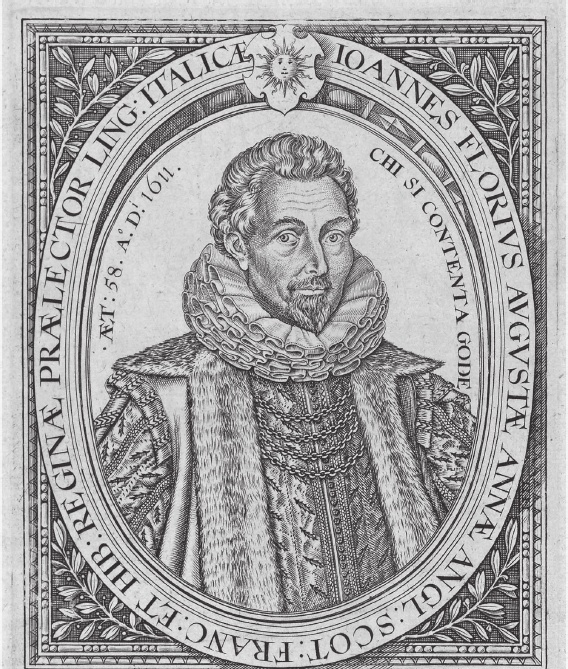
Engraving published in his work entitled Queen Anna’s New World of Words, 1611

John Florio’s birth is not recorded in any surviving parish register. Carla Rossi reconstructs the date from two later documents instead: the engraved portrait in the front matter of his 1611 dictionary, Queen Anna’s New World of Words, which states the sitter’s age as 58, combined with the Stationers’ Register entry for that same dictionary, which she dates to February 1611 Old Style (1612 New Style). Counting back from age 58 in February 1611/12 places his birth in August or the very first days of September 1552. As discussed above, Rossi and most later historians connect this birth to the affair between Michelangelo Florio and an unnamed maidservant in the Cecil household — the same episode described in Bishop Grindal’s 1568 letter — which appears to have cost Michelangelo his London ministry around 1550–52. Not every source agrees on the year: Italy’s Dizionario Biografico degli Italiani states that when Michelangelo fled London on 4 March 1554 he was accompanied by “la moglie e il figlio Giovanni, nato l’anno precedente” — his wife and son Giovanni, born the previous year, i.e. 1553 — which is closer to the traditional birth year still given in many older biographies. Rossi’s more granular calculation from the portrait and Stationers’ Register entry is generally preferred by recent scholarship, but the discrepancy is worth noting for anyone reconciling the family’s various birth dates.10

As an infant not yet two years old, John crossed Europe with his parents when the family fled England on Mary I’s accession. Michelangelo’s own account in the Apologia states the family left London on 4 March 1554 and reached Strasbourg on 6 May 1555; Strasbourg’s own municipal archives independently confirm the family’s presence there, recording in a charitable distribution of 2 January 1555 that Michelangelo “hat weib und kind” — has a wife and child.11 The family reached Soglio, in the Val Bregaglia, on 27 May 1555, as described above, and John was raised there through his father’s pastorate. Rossi places him at the University of Tübingen by 1563, matriculated at about age ten or eleven; she draws the record from Hermelink’s printed edition of the university’s matriculation register, though the original manuscript register (Tübingen University Archives, shelfmark UAT 5/26, vol. 3, p. 58) has since been cited independently for the same entry, giving John’s age as eleven rather than ten.12 Michelangelo and his wife — John’s mother, still unnamed in any surviving record — were both dead by mid-1573, and probably by 1566 specifically: a Bernese correspondence of that year already refers to Michelangelo’s death, and a Soglio notary who would otherwise have witnessed later Florio family transactions himself died in 1571 without ever doing so.13 The 1573 deed already discussed above, distributing “the linens, together with two gowns” that had belonged to “the late Lord Michael or to his late wife, mother of the said heirs,” almost certainly counts John among its unnamed plural “heirs” — he would have been orphaned in his early-to-mid teens.

John Florio next appears, firmly datable, in a census of resident foreigners taken in London on 10 November 1571, which records a French silk-dyer, Michael Baynard, as having “two seruantes, Baptist Clarencye and John Floren, Italions, of the Italion church.”14 Working in Baynard’s dyeing trade, Florio married on 5 February 1574 at St James Garlickhithe, London; the parish’s rough-draft register gives the bride’s name as “an sore fello,” and the fair copy as “Anne Sore sollo” — Rossi reads this as an Italian surname ending “-sollo” or “-sello,” i.e. “Anna Soresollo,” rather than the English surname “Sore.”15 The couple had six children, baptized at three different parishes as the family moved, and only one of whom survived to adulthood:

  • Annabelle (or Annable) Florence, baptized 1 April 1576 at St James Garlickhithe, her father recorded as “John Florence, dier.”16
  • Anne Florence, baptized 22 September 1577, same parish.17
  • Aurelia — recorded in the register as “Olrarie Floreus” — baptized 8 October 1578, same parish; the only one of the six to survive to adulthood, and the only child named in her father’s will.18
  • Joane, baptized 14 September 1585 at St Peter le Bailey, Oxford, showing the family had relocated there by that date.19
  • Edward, baptized 19 June 1588 at St Andrew Holborn, London, and buried there seven weeks later, on 8 August 1588.20
  • Elizabeth (“Elsabothe”), baptized 18/19 June 1589, same parish.

Joane and Elizabeth both disappear from the record after their baptisms and are presumed to have died as children during the severe London plague years of 1592–94; only Aurelia lived to be named in her father’s 1625 will.

Florio’s career as a language teacher and writer began while he was still nominally a dyer — his own dedication to Firste Fruites (1578) states plainly that teaching Italian “non è la mia professione,” is not his profession.21 He was incorporated at Oxford around 1580 (a university register sometimes read instead as 1581, an apparent clerical slip).22 By 1583 he was attached to the French embassy in London, where he formed a close friendship with the philosopher Giordano Bruno.23 He published a second Italian-teaching dialogue and proverb collection, Second Frutes, in 1591, and his first Italian–English dictionary, A Worlde of Wordes, in 1598 — later expanded as Queen Anna’s New World of Words in 1611.24 In 1603 he published his best-known work, an English translation of Montaigne’s Essays, and around the same time entered royal service as a Groom of the Privy Chamber and Italian reader to Queen Anne of Denmark, a post he held for the rest of her life.25 A continually debunked claim made over the years has been that he was the actual author behind the Shakespeare works, but this has been soundly refuted by various historians.

Florio’s first wife, Anne, does not appear in any record after their last child’s 1589 baptism and was presumably long dead by his second marriage. On 9 September 1617, at St James Clerkenwell, “John Florio Esquire” married Rose Spicer.26

A long-standing legend held that this second wife was “Rose,” a sister of the poet Samuel Daniel, and even that she was the model for Shakespeare’s “Dark Lady” — an idea Rossi traces to the nineteenth-century clergyman Nicholas John Halpin and rejects outright as unsupported by any archival record. Rose Spicer, from a Kent gentry family, outlived Florio: she is recorded at Fulham in April 1626, recently widowed and too poor to pay the parish poor-rate, and was buried at Hythe, Kent, on 27 July 1631.27

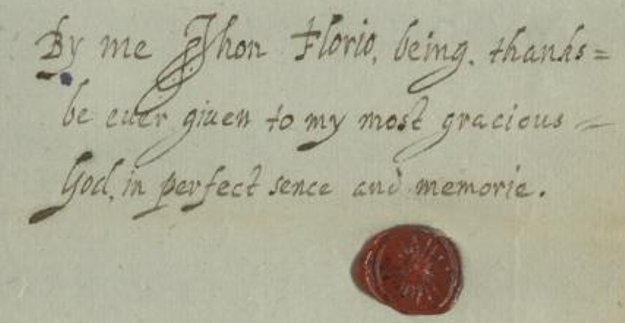
Florio wrote his will on 20 July 1625, describing himself as “of Fulham in the Countie of Middlesex, Gentleman.” He left Aurelia only “the wedding ring wherewith I maried her mother,” lamenting that poverty left him “not able to leave her anything els”; to James Molins he left a black velvet writing desk, embroidered with seed pearls, that had belonged to Queen Anne. The residue of the estate, along with his personal library of some 340 books, went to Rose — though the books, which he had asked to be sent to the Earl of Pembroke, never reached their intended destination; Rossi’s research suggests Rose instead sold part of the collection, including manuscripts of Florio family origin, to the lexicographer John Torriano. The named executors renounced execution of the will for reasons that were never recorded. Florio’s own autograph will survives at the National Archives, PROB 10/438, with a registered copy at PROB 11/149/289.28 It was proved in June 1626, meaning Florio died sometime between the will’s writing in July 1625 and its proving the following June — traditionally said to be of plague, at Fulham, in the autumn of 1625, though no burial record or surviving monument has been found.29

Seal and autograph on 1625 will

Aurelia Florio

No marriage record for Aurelia has been found, but she is identified securely as John Florio’s daughter both by his own will, which names “my daughter Aurelia” and “my sonne in law James Molins,” and independently by James Molins’s own 1638 will.30 She married James Molins (Mullens), a barber-surgeon of London, and raised a large family. Secondary literature credits Aurelia with becoming a noted London midwife, with helping examine ten Lancashire women accused of witchcraft on 2 July 1634 (the examination found no evidence supporting the accusations), and records her death “a rich widow” in London on 12 July 1641.31 She left a will dated 7 Feb 1640/1. She described herself as “Aurelia Molins widowe late wife of James Molins tholder cittizen & Barber Chirurgion of London deceased.” She named her children including “my daughter Aurelia Cox the wife of William Cox” to whom she gave five pounds.32 She was buried at St. Andrew, Holborn on the 13th, the entry also noting her death on the 12th at the house of Will “Monllins.”33


  1. Rossi, Carla. Italus ore, Anglus pectore: studi su John Florio. Vol. 1. Studies & Essays 2. London: Thecla Academic Press, 2018. ↩︎
  2. Florio, Michelangelo. Apologia, p34 ↩︎
  3. Rossi, Carla. “La fede di battesimo di Michelangelo Florio, nato a Firenze, addì 28 settembre 1518 a hore 12.” Theory and Criticism of Literature and Arts (TCLA), vol. 2, no. 1 (November 2017): 96–115. ↩︎
  4. Sloane MS 3011, British Library, https://searcharchives.bl.uk/catalog/040-002115395 ↩︎
  5. Strype, John. Memorials of the Most Reverend Father in God Thomas Cranmer, Sometime Lord Archbishop of Canterbury. New ed., with additions. Vol. 1. Oxford: Clarendon Press, 1812. Internet Archive. ↩︎
  6. Strype, John. Memorials of the Most Reverend Father in God Thomas Cranmer, Sometime Lord Archbishop of Canterbury. New edition, with additions. Vol. 2. Oxford: At the Clarendon Press, 1812. Appendix, Records, no. LIII, p. 883. ↩︎
  7. Strype, John. Memorials of the Most Reverend Father in God Thomas Cranmer, Sometime Lord Archbishop of Canterbury. New edition, with additions. Vol. 2. Oxford: At the Clarendon Press, 1812. Appendix, Records, no. CVII, p. 1036. ↩︎
  8. Rossi cites British Library, London, Lansdowne MS XLV, no. 29, fol. 65–66 ↩︎
  9. Staatsarchiv Graubünden (Chur), Codice/Protocol B 663/27, fol. 48 (full text of the act), with the filing/index notation at fol. 10v. Notarized by Johannes Ruinella (Giovanni Ruinelli), notary of Soglio/Val Bregaglia. ↩︎
  10. Perini, Giovanna. “Florio, Michelangelo.” Dizionario Biografico degli Italiani, vol. 48 (1997), Istituto della Enciclopedia Italiana (Treccani). treccani.it ↩︎
  11. Florio, Michelangelo. Apologia (1557), pp. 108–112; Archives de la ville et de l’Eurométropole de Strasbourg, collection 1 R – Conseil des XXI – Procès-verbaux, 1 R 17, fol. 269v, and Procès-verbaux 1554–1555 (old shelfmark AA 638), fol. 410v (quoted in Rossi 2018, pp. 71–74). ↩︎
  12. Rossi 2018, pp. 150, 153, 155–156, citing H. Hermelink, Die Matrikeln der Universität Tübingen 1477–1817, Stuttgart, 1906, p. 434, no. 159.9; cf. Eberhard Karls University of Tübingen Archives, shelfmark UAT 5/26, vol. 3 (1545–1564), p. 58. ↩︎
  13. Burgerbibliothek Bern, ms. A.93.II (Torriani correspondence); Rossi 2018, p. 159, citing also Lentolo’s Commentarii and the record of the Soglio notary Nicola Mora’s death, May 1571. ↩︎
  14. Returns of Aliens Dwelling in the City and Suburbs of London from the Reign of Henry VIII to that of James I, Huguenot Society Proceedings, vol. X, part II, 1902, p. 124; cf. UK National Archives, Kew, S.P. 12/82, fol. 104, State Papers Domestic, Elizabeth I, 1571 (Rossi 2018, p. 162). ↩︎
  15. London Metropolitan Archives, St James Garlickhithe, Composite register 1535–1621, P69/JS2/A/001/MS09138, fol. 44, and Composite register: baptisms and burials 1535–1693, marriages 1535–1692, P69/JS2/A/002/MS09140 (Rossi 2018, pp. 208–210, 175). ↩︎
  16. London Metropolitan Archives, St James Garlickhithe, P69/JS2/A/001/MS09138, fol. 47 (Rossi 2018, pp. 175–176). ↩︎
  17. London Metropolitan Archives, St James Garlickhithe, P69/JS2/A/001/MS09138, fol. 51 (Rossi 2018, p. 176). ↩︎
  18. London Metropolitan Archives, St James Garlickhithe, P69/JS2/A/001/MS09138, fol. 56, and P69/JS2/A/002/MS09140 (Rossi 2018, pp. 176, 178). ↩︎
  19. Register of St Peter in the Baylie, Oxford (Rossi 2018, p. 218). ↩︎
  20. London Metropolitan Archives, St Andrew Holborn, Register of Baptisms 1558–1623, P82/AND2/A/001/MS06667, and Register of Burials, P69/AND2/A/010/MS06673 (Rossi 2018, pp. 219–220). ↩︎
  21. Florio, John. Firste Fruites, London, 1578, dedication (Rossi 2018, p. 182). ↩︎
  22. Rossi 2018, pp. 214, 216–217, citing A. Clark, ed., Register of the University of Oxford, vol. II, pt. I (Oxford Historical Society, 1887), p. 392. ↩︎
  23. Rossi 2018, pp. 221–230; Public Record Office, S.P. 78.14, nos. 84–85, ff. 186–187. ↩︎
  24. Florio, John. Florios Second Frutes, London, 1591; A Worlde of Wordes, London, 1598; Queen Anna’s New World of Words, London, 1611. ↩︎
  25. Rossi 2018, p. 252; licensing entry of 4 June 1600 to Edward Blount, Stationers’ Register. ↩︎
  26. London Metropolitan Archives, St James Clerkenwell, Composite register, P76/JS1/004 (Rossi 2018, pp. 212–213). ↩︎
  27. Rossi 2018, pp. 206–208, citing A. Burl, Shakespeare’s Mistress, Amberley Publishing, Stroud, 2012; Hythe Library, Parish Records, St Leonard, Burials 1586–1920, ref. KFHS-2223. ↩︎
  28. The National Archives, PROB 10/438, PROB 11/149/289 (Rossi 2018, pp. 266–284). ↩︎
  29. Anthony à Wood, Athenae Oxonienses, ed. P. Bliss, Oxford, 1813, vol. II, p. 269; Rossi 2018, pp. 266–267. ↩︎
  30. Prerogative Court of Canterbury Piece 178 (Lee), folio 478 reverse ↩︎
  31. G. Morris, “Molins, James,” Oxford Dictionary of National Biography, 2004; John Carey, Eyewitness to Science, Harvard University Press, 1995, pp. 21–22. ↩︎
  32. London Metropolitan Archives, MS 9052/10; Will Number: 212 ↩︎
  33. London Metropolitan Archives, St. Andrew, Holborn, Composite register, 1623-1642, P69/AND2/A/010/MS06673/002 ↩︎

Coxe (Cox)

The Coxe (from now on Cox) family was from London as far back as has been traced. Although there are speculations that a Robert Cox was the earliest ancestor, four brothers, Henry, John, George and William are known to have been active in the parish of Holborn St. Andrew of London in Middlesex County in the mid-1600’s. There was a Robert Cox and “Syth Moare” who were married in that parish on 22 Nov 1607 who might possibly be the parents.1 John, his nephew Henry Cox and his niece, Ann Cox Cawthorne (our ancestor) all ended up in the colony of Virginia. It is important to follow three of the brothers as some of the information we have on them fills out the picture of the migration of this family.

John Cox lived in Old Rappahannock County, Virginia and had passed away by 5 Jan 1670/1 when John Hull and George Mott were granted bond on his estate.2 He left a will dated 9 Nov 1669 recorded in Old Rappahannock County records, but the original will must have been damaged as there are significant portions that are skipped over intentionally as if they couldn’t be read.3 However, among the items is included that “I do hereby constitute & ordaine my well beloved kinsman Henry Cox ye sonne of my brother William Cox & now present in Virginia my sole…..this my Last Will & Testament.”

George Cox, the other brother, left a will dated 26 Oct 1683 that was proven in the Prerogative Court of Canterbury 6 Jul 1686.4 He styles himself “citizen and haberdasher of London.” A haberdasher was a merchant who sold everyday items for clothing and sewing. The Worshipful Company of Haberdashers was a London guild which many gained apprenticeships through. He stated that he gave “my messuage or tenement and shopp now knowne by the signe of the Rose situate in Holborne in the parish of St. Andrews Holborne London with appurtenances unto my nephew Henry Cox.” He also mentions that if for some reason Henry had no issue or could not inherit then it would go to “George Cox sonn of my late brother Henry Cox” and if he died then to “my nephew John Cox and his heires male.” He mentions nieces Mary Hampstead, Elizabeth Byrar(?), children of a niece Joane Parker, nephew Richard Lucas; Mary, Sarah and George Cox, children of his nephew George Cox and others.

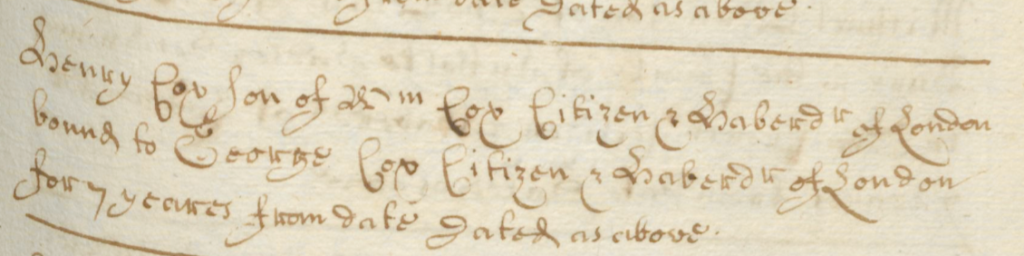
What helps further tie these individuals together with the third brother William is the nephew Henry and their occupation. George gives special attention to his nephew Henry Cox who was to inherit is place as the primary heir. We find that Henry had been apprenticed to George on 6 Sep 1667.5 His father William is also described as haberdasher and citizen of London. George himself is noted as having become a freeman (graduated from an apprenticeship) in 1640 with his master as William Cox.6 This is presumably his brother.

William Cox

As has already been established, William was a haberdasher of London. He became a freeman in 1632 through apprenticeship to Frances Martyn.7 Apprenticeships were generally seven years long, so he apparently became master to his brother George soon after gaining freeman status for George to gain status of freeman in 1640.

William was married to Aurelia Mollens (also spelled Mullens, Mollins, etc.) on 23 Jun 1635 at St. Mary, Stoke Newington, Middlesex County.8 She was the daughter of James Mollins who mentioned her in his will from 1638, stating “my three daughters…Aurelia Cox wife of William Cox.”9

The baptisms of their six known children were all recorded at St. Andrew, Holborn.10,11 Note that William is called a hosier, someone who sold socks, stockings, leggings, etc and was considered a type of haberdasher.

  • Aurelia Cox daughter of William Cox hozier and of Aurelia his wife Beetweene the Bridge and Sho Lane End in Holborne bapt 13 (Aug 1639)
  • Ann Cox dau: of William Cox hosier & of Aurelia his wife borne in his house neare holborne Birdge and was bapt the 7 (Feb 1642/3)
  • John Cox sonne of William Cox hozier and of Aurelia his wife bourne in his house neare Holborne Bridge bapt the 8 (May 1645)
  • Thomas Cox sonne of William Coxe haberdasher neare holborne Bridge and Aurelia his wife borne at Newington Butts? by Lambeth but baptized by the minister of this parish his father and mother dwelling in this parish 4th July 1648
  • James Cox Sonne of William Cox Haberdasher and of Aurelia his wife by Holborne Bridge was bap: the 4th (Aug 1650)
  • Henry Cox Sonne of William Cox Haberdasher and of Aurelia his wife neare holborne bridge was bapt 18 (Mar 1651/2)

William’s wife Aurelia died and was buried at St. Andrew, Holborn in 1654.12 William may be the William Cox buried at St. Andrew, Holborn on 20 May 1663. However, his son Henry was apprenticed to his uncle George in 1667 and it states he was son of “Wm Cox Citizen & haberdr of London” which would be odd if William had already died. Also that burial entry states that William was in Castleyard in Holborne, so he may have moved if this is the same individual.

Ann Cox

Ann was baptized in 1643 and was married to Richard Cawthorne on 13 May 1668 at St. Mary’s, Harefield, Middlesex, not far from London.13 They, along with their daughter Aurelia and Ann’s brother Henry, were transported to Virginia by Thomas Gouldman sometime before 23 Sep 1674 when Gouldman received a land grant of 2200 acres for transporting a total of 44 persons.14 It would seem however that they were transported in 1669 as Henry is mentioned in his uncle John Cox’s will from that November as “Henry Cox ye sonne of my brother William Cox & now present in Virginia.”

Ann is further identified as Ann Cawthorn(e) through the will of Henry Cox. He did not live long in the colonies but died in Oct 1675, leaving a will dated 22 Feb 1674/5 which includes the following item: “I give unto my Brother in law Richard Cawthorn my best Cloath suite, my best hatt & a pair of french falls, & a pair of stockings both new to be delivered to him immediately after my death. Item I give unto Richard Cawthorn junr my nephew and to Aurelia Cawthorn my neece each of them a cow calfe to be delivered them about the beginning of June next after my death.”15

It is not known when Ann died. However, when Richard’s will was proved in 1687 and then later in 1689, the court appointed guardians for the three children, described as orphans. Aurelia is incorrectly named Ann in the record which states: “Ordered that Mr. John Waters take under his care & tuition the two orphans of Richard Cauthorne of this County decd by name Richard & Ann, and that the boy continue wth the sd Waters untill he atteyne the age of Eighteen years, the Girle till sixteen. The sd Waters obligeing himself to give the sd Richard two years schooling & to finde the sd orphans during the respective terms time aforesd cloathing dyett & lodging convenient.”16 The youngest, Thomas, was put in the case of Rebecca Moss in 1689 to stay with her unto the age of fifteen “& that then he be payed corne & clothes according to the custom of other servants.”17


  1. Saint Andrew, Holborn, Middlesex Parish Register 1559-1698, London Metropolitan Archives, P69/AND2/A/002/MS06668/001 ↩︎
  2. Old Rappahannock County, Virginia Deed Book 4, 1670-1672, pp. 442-443, FamilySearch (https://www.familysearch.org/ark:/61903/3:1:3QS7-89P6-3J6W) ↩︎
  3. Essex County (Old Rappahannock County), Virginia Deed & Will Book, Volume 9, 1695-1699, pp. 12-13, FamilySearch (https://www.familysearch.org/ark:/61903/3:1:3QSQ-G9P6-3W5C) ↩︎
  4. Prerogative Court of Canterbury Piece 384 (Lloyd), folio 17 ↩︎
  5. Worshipful Company of Haberdashers, Register of apprentice bindings 1655-1675, p171, London Metropolitan Archives, CLC/L/HA/C/011/MS15860/006 ↩︎
  6. Worshipful Company of Haberdashers – Register of freedom admissions 1526-1613, p238, London Metropolitan Archives, CLC/L/HA/C/007/MS15857/001 ↩︎
  7. Worshipful Company of Haberdashers – Register of freedom admissions 1526-1613, p215, London Metropolitan Archives, CLC/L/HA/C/007/MS15857/001 ↩︎
  8. Saint Mary, Stoke Newington, Middlesex Parish Register 1560-1812, London Metropolitan Archives, P94/MRY/001 ↩︎
  9. Prerogative Court of Canterbury Piece 178 (Lee), folio 478 reverse ↩︎
  10. Saint Andrew, Holborn, Middlesex Parish Register 1623-1642, London Metropolitan Archives, P82/AND/A/001/MS06667/002 ↩︎
  11. Saint Andrew, Holborn, Middlesex Parish Register 1642-1654, London Metropolitan Archives, P82/AND/A/001/MS06667/003 ↩︎
  12. Saint Andrew, Holborn, Middlesex Parish Register 1653-1672, London Metropolitan Archives, P69/AND2/A/010/MS06673/004 ↩︎
  13. St. Mary’s, Harefield, Middlesex Parish Register 1538-1812, London Metropolitan Archives, DRO/080/001 ↩︎
  14. Virginia Land Patents, Vol. 6 (1666-1679), p526, FamilySearch (https://www.familysearch.org/ark:/61903/3:1:3Q9M-CSLZ-PS2V-N) ↩︎
  15. Old Rappahannock County, Virginia Will Book 1, 1665-1677, pp. 191-194, FamilySearch (https://www.familysearch.org/ark:/61903/3:1:3Q9M-C9PX-2S3M-3) ↩︎
  16. Old Rappahannock Order Book, Vol. 2, 1686-1692, p17, FamilySearch (https://www.familysearch.org/ark:/61903/3:1:3Q9M-C9T3-P3W5) ↩︎
  17. Old Rappahannock Order Book, Vol. 2, 1686-1692, p199, FamilySearch (https://www.familysearch.org/ark:/61903/3:1:3Q9M-C9T3-PSJ4) ↩︎

Cawthorne (Cauthen)

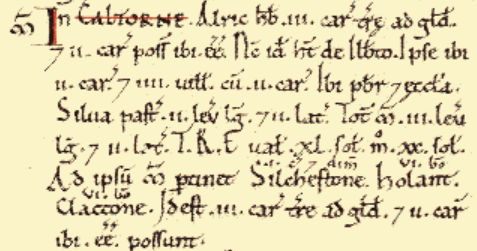
The Cawthorne family originated in Yorkshire in England as far back as can be traced. Our earliest known ancestor, Richard Cawthorne, hailed from Darfield, historically a parish in the West Riding of Yorkshire, located about twenty miles south of Leeds. About eight miles to the west, and directly south of Leeds, lies the parish of Cawthorne, an ecclesiastical parish created in 1608. The name Cawthorne derives from Old English and means “cold thorn.” There were a number of families living in this area of Yorkshire using the name Cawthorne in the mid-1600’s. But the location was known as far back as 1086, appearing in the famous Domesday Book as “Caltorne.” It was a small settlement at the time, described as having 1.3 households that year.1 The surname appears to have been adopted by various families associated with this area.

Caltorne entry in the Domesday Book

Maryline Cauthen Westenhaver of Auburn, Alabama published a book entitled Cauthen Family History in 1980 which includes thorough research of our Cawthorne/Cauthen family, tracing Richard’s family to London, Virginia, North Carolina, and South Carolina where our line connects to the Cole family. Much of what is contained here is a summary of the information presented in that book.

Richard Cawthorne (of Yorkshire)

The earliest records concerning Richard associate him with Darfield and Milnehouse, areas just east of Barnsley and about twenty miles south of Leeds. The Feet of Fines records include various land and property transactions in Yorkshire. Richard Cawthorne is mentioned in two records from 1608 and 1609.2 The first mentions land in Darley Edge, Darley, Worsburgh and Worsburghdale and the second in Ardsley and Darfield. All of these are located right by Darfield and Barnsley. He is also mentioned in a record from 1617 alongside a Henry Cawthorne and John Kay concerning land in Carle Cotes, Thurleston, Worsbrough and Worsbroughdale, all located in that same general area.3 Richard Cawthorne, described as a tanner of Milnehouse, along with Lawrence Kirkes were recipients of a deed of settlement by John Woodward on 5 Jul 1613 “in trust for the use of himself and his wife for their live.”4 This meant that the piece of property described in the deed was held in trust by Cawthorne and Kirkes until Woodward and his wife were deceased and then their heirs would own it, bypassing the probate process.

In 1640, a meeting of the Court of Quarter Sessions recorded that Henry Preist of Haxey in Lincolnshire, laborer plead guilty to stealing on 9 Mar 1639/40 five swine from Richard Cawthorne at Milnhouse.5 This appears to be the same Richard Cawthorne as Haxey is located about twenty miles to the east of Darfield and the Milnhouse mentioned previously appears to be the best identification of the location mentioned here.

Not much is known of Richard’s later life besides a record establishing the relationship to his son until his death in 1658. His burial on May 12th is recorded in the parish register of Darfield which describes him living at Milnhouse.6

Early Connections

Clues to Richard’s extended family are found in the will of Mrs. Douglas Burton dated 15 Sep 1651 and probated in the Prerogative Court of Canterbury, the highest probate court in England.7 Douglas was often used as either a male or female name in the 17th century. She describes herself as “somtyme of Doncaster in the County of Yorke and now of London widdowe.” In the first item she made “Thomas Crawthorne tanner Richard Crawthorne tanner and Elizabeth Jefferson” her executors. She also mentions “Thomas Crawthorne sonne of Samuell Crawthorne of Seffeild in the County of Yorke.” Crawthorne is a misspelling of Cawthorne as appears later in an earlier text appended to the entry for her will, described as “the desyre of Mrs. Burton upon her death bedd” dated 12 Sep 1651. This is dated three days previous to the will and gives further information. Consistently using the spelling Cawthorne, she again states that Thomas Cawthorne, Richard Cawthorne, Elizabeth Jefferson were her executors. She then also makes various bequests to the following relatives: her sister Anne and Anne’s children Thomas, William, Francis, Anne, Elizabeth and Martha; her sister Elizabeth and her two children; her sister Mary; her uncle Richard Cawthorne; her cousin Thomas Cawthorne and his children William, John and Richard.

Doncaster is located just under ten miles east of Darfield. With Richard being described in other records as a tanner, it’s pretty clear this is the same individual being referred to in Mrs. Burton’s will. Douglas Cawthorne was married to William Burton on 12 Mar 1634/5.8 This is recorded in the parish register at Doncaster. No baptism record for Douglas has been found so it is not clear who her parents were, but her uncle Richard Cawthorne would appear to be the same Richard as our earliest known Cawthorne ancestor.

Richard Cawthorne (of London)

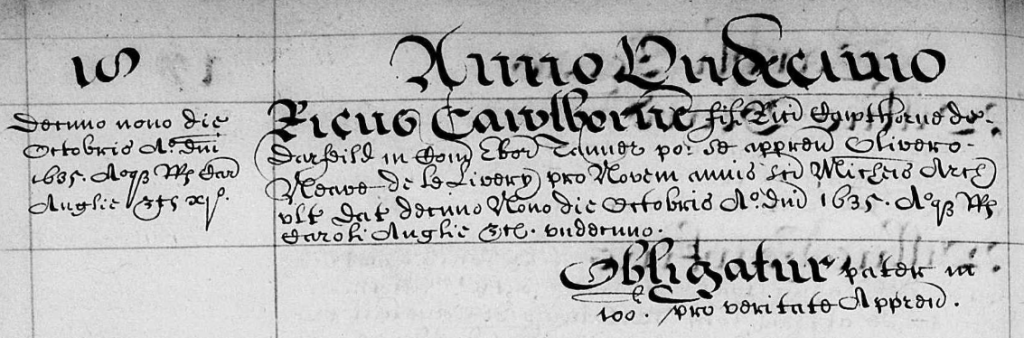
Although no baptism records have been found for him, Richard Cawthorne of Darfield is known to have had a son named Richard who was enrolled as an apprentice in the Merchant Taylors Company of London in 1635.9 This would have taken place between age 14 and 21, and typically around age 16-18. His age at his second marriage puts his year of birth about 1620. The apprenticeship record is in Latin and states that “Richard Cawthorne son of Richard Cawthorne of Darfield in County York tanner” was apprenticed to Oliver (Neave?). This was a time of thriving business for trade that the Merchant Taylors Company was involved in. With the founding of Jamestown in 1607 by the Virginia Company in which the Merchant Taylors Company was strongly invested, these businessmen looked to long-term rewards through goods gained in the colonies.

Richard Cawthorne of London’s eldest son, Richard, was baptized at St. Mary’s, Woolchurch Haw on 27 Jan 1644/5.10 While the baptisms for his younger children do not include the mother’s name, this baptism reveals that Richard’s wife was named Mary.

The following entries for his younger children’s baptisms appear in the registers of the parish just to the west, St. Mildred’s, Poultry.11

  • (1646 Apr) The ix Mary daughter of Richard Cawthorne
  • (1647 Dec) The xvii Thomas son of Richard Cawthorne
  • (1648/9 Feb) The xii William son of Richard Cawthorne
  • (1650 Dec) The xviii James son of Richard Cawthorne

Richard was to remarry in 1673, so his wife Mary was deceased by that time. It appears she was probably the Mary, wife of Richard Cawthorne recorded in the burial register for St. Stephen’s, Coleman Street in 1669.12 Oddly, it seems to indicate she was actually buried elsewhere. St. Stephen’s is just a couple parishes to the north of St. Mildred’s.

Two of Richard’s sons, Richard and Thomas, were admitted to the Merchant Taylor’s in 1668 and 1669, respectively.13

In 1673, Richard, described as as widower in the marriage allegation, age 53, of St. Mildred’s, Poultry, was married to a widow named Anne Abrahall, of London. The marriage took place August 28th at Greenwich, St. Alfege, Kent, just outside of London and was recorded in the parish register there.14,15

Richard died in December 1687. The parish register at St. Mildred’s, Poultry states that he was buried on the 3rd in the great vault.16

Richard wrote his will on 19 Nov 1687 and it was probated in the Prerogative Court of Canterbury on December 10th.17 He describes himself as a citizen and merchant-taylor of London. The will reveals that Richard was owed around 800 pounds by the Crown for “goods delivered and services done in the Tower of London.” He mentions his son Richard, three grandchildren named William, Elizabeth, and Mary Lothwait, children of his son-in-law William Lothwait, and Anee Abrahall, daughter of Thomas Abrahall, presumably his step-daughter. He also names Thomas, Edward, Hester, Elizabeth and Mathew Gibbons, children of Matthew Gibbons, who received ten pounds each. The relationship is not stated. Finally he mentions his wife Anne who was appointed executrix.

Richard Cawthorne (Immigrant)

Richard was baptized at St. Mary’s, Woolchurch Haw, London on 27 Jan 1644/5, so was likely born shortly before that. Richard was admitted to the Merchant Taylors Company by the patronage of his father, Richard, in 1669.18 He was married to Anne Cox on 13 May 1668 at St. Mary’s, Harefield, Middlesex, not far from London.19

Richard, his wife Anne, and their daughter Aurelia traveled to Virginia by late 1674. The government issued land grants to those who would transport persons to Virginia. The records for these grants include the names of passengers transported. Thomas Gouldman received 2200 acres of land on 23 Sep 1674 for transporting forty-four individuals. Included in the list are Richard, his wife Ann, daughter Aurelia, and brother-in-law Henry Cox.20

Henry Cox did not live long after arriving in the colonies. He left a will dated 22 Feb 1674/5 which includes the following item: “I give unto my Brother in law Richard Cawthorn my best Cloath suite, my best hatt & a pair of french falls, & a pair of stockings both new to be delivered to him immediately after my death. Item I give unto Richard Cawthorn junr my nephew and to Aurelia Cawthorn my neece each of them a cow calfe to be delivered them about the beginning of June next after my death.”21 This establishes that Richard’s son Richard was born before early 1675.

Richard, living in the parish of Sittingbourne in the old County of Rappahannock, Virginia wrote his will in early 1680 which mentions his wife Ann, his eldest so Richard and his son Thomas. Since no others are mentioned, it’s likely Aurelia had died by that point. Richard apparently chose to write the will at this time because he was about to travel back to England.

Later that same year, he was back in London where he received power of attorney from his father and step-mother to collect money owed to the deceased late husband of his step-mother, Thomas Abrahall, by the estate of Robert Abrahall of New Kent County in Virginia. This was recorded between 2 Mar and 11 Jul 1681 in Middlesex County, Virginia, indicating that he was back in Virginia by then.22

The will which Richard had written was proved 2 Mar 1686/7 “by comparison of hands,” indicating that the witnesses had either passed away or could not be found and so the handwriting in other records served as comparison to prove his will.23

Richard Cauthorn (of Essex County)

Richard was born before early 1675 when he was mentioned in his uncle Henry Cox’s will. Given that the family seems to have traveled to Virginia only a few years previous to that, Richard was likely born around 1674.

Old Rappahannock County, where the Cawthorne family lived was split into two different counties in 1692, Essex and Richmond. Records of this family continue to appear under Essex County after that time. In 1705, Richard bought seventeen acres of land in Tappahannock, the oldest town in Essex County.24 This property was passed down the family and a Cauthen descendant was still living there in the 1950’s according to the Cauthen Family History.

Richard’s wife Ann is mentioned in the will of Vincent Vass of South Farnham Parish in 1726.25 It mentions “Ann Cauthorn, the wife of Richard Cauthorn, she being my daughter in Law, four cows.” The term “in-law” often referred to the same relationship we would term step-children. The Cauthen Family History mentions several records which indicate that Vincent Vass’s wife Ann had been previously married twice, first to Thomas Roberts,26 then to Thomas Gillett.27 So it’s possible that Ann Cauthorn was the daughter of one of these men and Ann who would later marry Vincent Vass.

Richard wrote his will on 28 Nov 1747 and it was proved 18 Oct 1748, so he likely died in or close to October 1748.28 In it, he names children Richard, James, Vincent, William, Henry, Catherine Duncan, Ann, and grandchildren John and Mary, children of a son Thomas who had already died.

James Cauthorn

James, son of Richard, decided to move away from Virginia and settled instead in Warren County, North Carolina. On 5 Feb 1767, James and Betty Baxter of Bute County, North Carolina sold two hundred acres of land in Bute County to “James Cauthron of Essex County of the Colony of Virginia.”29 The deed was witnessed by Dawson Vanlandingham, who would later also move to Lancaster County, South Carolina. Warren County was formed from Bute County in 1779. Later that same year, James Cauthorn and his wife Elizabeth sold some land to his brother Vincent, “it being the land devised to the said James Cauthorn by the will of his Father Richard Cauthorn deceased and whereon he now lives.”30 He must have moved to Bute (later Warren) County shortly after this.

James did not leave a will. He made a deed of gift to his younger children in 1801, stating it was “for and in consideration of the love and affection I have for my six children, viz – Henry, Peggy, Vincent, Nancy, Reubin and Patsy Cauthorn.”31 His older children, Thomas, John, James, William and Benjamin have been deduced through other records which are described in the Cauthen Family History. His son Thomas is proven through the 1771 tax list for Bute County which lists James living next to Dawson Vanlandingham and lists taxable individuals as “James Cothorn self and son Thos negroes Robin & Frank.”32 His son John’s will from 1794 mentions a “tract I bot of my Brother Thos.”33

James was still living in Warren County in 1805 when he sold 161 and 1/2 acres of land “it being part of the tract whereon the said [James] now lives it being the land he purchased of James Baxter.”34

Thomas Cauthen

Thomas35,36,37 and his brothers James38 and William39 saw service in the Revolutionary War from North Carolina. This is known to be the case from several pay vouchers from their service from 1781 and 1782 from Halifax District, an administrative military district which included Bute and the later Warren counties.

Revolutionary War Payment Voucher from 1781 for Thomas Cauthron

James and William are listed close by one another in Warren County in the 1790 census.40 It’s not clear if Thomas was accidentally left out or if he had already moved by that point. Indexes do not show a Thomas with Cauthorn or similar name on the 1790 census at all. By 1800, they were all living in Lancaster District, South Carolina. James and William were living next door and are listed under the name Cochran.41 Thomas was listed as Cathorn.42 It appears that Thomas may have been briefly in Mecklenburg County, North Carolina before moving down to South Carolina. There is a deed recorded in Lancaster County from 1790 of Robert Montgomery selling some land in the Waxhaw Settlement to “Thomas Cauthorn of the County Mecklenburg and State of North Carolina.”43 In 1796, William Prewer sold some land in Lancaster District to James Cauthorn.44 It was witnessed by William Cauthorn and Henry Vanlandingham and proved by William Cauthorn. Henry Vanlandingham was a son of Dawson Vanlandingham who had been a neighbor of the Cauthorns in Bute and Warren County, North Carolina. It appears a number of families from that area moved down to the Lancaster County area together. In fact, the Cauthens settled nearby an area that was dubbed Warrenton, near the Lancaster and Kershaw County borders. A historical marker for this area states that “The area was named Warrenton after thirty families from Warrenton, N. C. settled here shortly after the American Revolution.”45

We don’t possess any records showing when Thomas died. However the Cauthen Family History states that a descendant had an old paper written by their grandmother which stated Thomas Cauthen was born in 1750 and died 19 Jan 1822. The Cauthen Family History also includes an excerpt from a letter of Thomas’s granddaughter Amanda Cauthen, daughter of Big George Cauthen, stating that her grandparents were Thomas Cauthen and Elizabeth Vanlandingham (see p199). It is thought she was likely a close relative of Dawson Vanlandingham whose family had been neighbors back in North Carolina and had also moved to Lancaster County.

What is often termed an “heirs deed” gives us the list of Thomas’s children. Dated 19 Jan 1824, it begins “Know all men by these presents that We John Cauthen, Thomas Cauthen, William Cauthen, James Cauthen, George Cauthen, Robert Champion, Richard Sessions, & James Baily heirs of Thomas Cauthen deceased.”46 It then goes on to describe the 616 acre tract of land they were selling to Robert Cunningham Sr. It was located on “Rocky Creek branch waters of Cedar Creek.” Later the wives of the men also signed into the deed. The daughters of Thomas Cauthen were Nancy Champion, Rebekah Bailey and Mary Sessions.

Although it is not known where he or the other brothers are buried, the writer of the Cauthen Family History suggests it could have been the old Hanging Rock Presbyterian Church Cemetery. Besides a family cemetery, the other candidate would be the Hanging Rock Methodist Church Cemetery where some of the later generations are buried. In 1976 a large stone was placed in the Salem Cemetery by the DAR commemorating the service of Thomas, James and William in the Revolutionary War. Several other soldiers whose graves are not known also received commemorative stones there.

Thomas Cauthen Jr.

Thomas was born about 1780 according to the age on his headstone. He probably married his wife Nancy about the year 1803 as their first child was born the next year. Her maiden name is believed to have been Stevens, but there is no proof of this. Thomas began buying land in 1804, the same year his first child was born. He bought 100 acres on Cedar Creek.47 Later he continued to buy more land and settled in the Hanging Rock area. He built a house which stood into the mid 1900’s. A photo is included here from the Cauthen Family History. Mr. and Mrs. W. L. Phillips bought the home place of Dr. William Columbus Cauthen in 1945 and the old Cauthen place was also on that land at the time. As related in Cauthen Family History: “In 1951 Henry F. Cauthen of Columbia visited Mrs. Phillips, and they walked through the woods to see what was left of the old house. They found square-cut log walls of part of it still standing, the stone chimney and fireplace of the main room still intact, the roof gone and the upper floor mostly fallen in. Snapshots taken then show that it had been a story and a half high and had been finished on the inside with smooth, horizontal boards about eight inches wide. The outside had been covered with wide siding, probably at a later date. The house had consisted of a main room about 22 feet long by 12 feet wide with a great fireplace at one end over four feet wide. A heavy wood mantel shelf attached to the stone chimney face was still in place. In one corner of the main room were remains of a steep, enclosed stairway to the upstairs which had headroom at the side walls of about four feet.”

The family of Thomas Cauthen was recorded in a Family Bible which at one point was owned by his son Dr. William Columbus Cauthen. The heading states: “Births of wife and children of Thomas Cauthen Jr., who died May 17, 1872 – age 92.” His wife’s entry states “Nancy Cauthen – December 14, 1787 – Died March 3, 1849.” The entries for the children are included below. Parts can be difficult to read. The names of the children were: Elizabeth, Mary Matilda, Nancy, Malinda, Sarah, Drucilla, Polly, Thomas Jefferson, Cynthia Ann, Eliza Theresa, Lewis Marion, Missouri Rebecca, William Columbus, Elvira Jane, Andrew Jackson.

Thomas’s son Dr. William Columbus Cauthen was a prominent man in Lancaster County. He graduated in 1847 from the Medical School of Transylvania College, Lexington Kentucky and set up his practice in his father’s home. He built a home soon after which is the oldest still standing residence in Lancaster County and is on the Nation Register of Historic Places.48 He was also one of the three men from Lancaster County who signed the Ordinance of Secession for South Carolina.49

After Nancy died in 1849, Thomas remarried to Rebecca, widow of John Fleming. This is established through a deed from her son John Fleming to her where he releases his claim to his father’s estate. He refers to her as “my mother Rebecca Fleming now wife of Thomas Cauthen.”50 Rebecca is listed with Thomas on later census records.51 Thomas died in 1872 and was buried in the Hanging Rock Methodist Church Cemetery along with his wife Nancy.52 The headstone refers to him as Thomas Cauthen Sr. since his own father had long since passed and he had his own son named Thomas. This was customary at the time.

Missouri Rebecca Cauthen

Missouri Rebecca Cauthen, the twelfth child of Thomas and Nancy Cauthen, was born 3 Mar 1824 according to the Cauthen Family Bible. The Hicklin Family Bible records the following for her marriage:53

  • William A. Cole was married to Missouri Cauthen 23rd February A.D. 1843

Her husband William Cole died 28 Jan 1865 on the way home on sick furlough from the Civil War. William left a will dated 28 Aug 1863.54 He mentions his wife Missouri R. Cole and “my seven children, viz. Rebecca Jane, Elizabeth Drucila, Nancy Louisa, Mary Elvira, John Wesley, Lewis Thomas, and Andrew Columbus.”

Missouri died in 1907 and was also buried in the Hanging Rock Methodist Church Cemetery according to her obituary, although with no marker.

The Lancaster News, 19 Jan 1907

  1. Cawthorne entry on Open Domesday, Domesday Book, Yorkshire folio 38 ↩︎
  2. Brigg, William, B. A. (1915). Yorkshire Fines for the Stuart period. Volume 1. 1-11 James I, 1603-1614, p. 93, 101 ↩︎
  3. Brigg, William, B. A. (1915). Yorkshire Fines for the Stuart period. Volume 2. 12-22 James I, 1614-1625, p. 86 ↩︎
  4. West Yorkshire Archive Series, 1613 Deed of Settlement, WYW1849/DD70/Bundle 61 ↩︎
  5. Lister, John, M. A. (1915). West Riding Quarter Sessions Records. Volume II, p186 ↩︎
  6. Darfield, Yorkshire Parish Register, Doncaster Archives, P81-1-A1, p64 ↩︎
  7. Prerogative Court of Canterbury Piece 218 (Grey), folio 201 reverse ↩︎
  8. Doncaster, Yorkshire Parish Register 1557-1743, Doncaster Archives, P1/1/B1, p33 ↩︎
  9. London Merchant Taylors Company, Membership Records, Vol. 11 (1635-1639), p18, FamilySearch (https://www.familysearch.org/ark:/61903/3:1:3Q9M-CSH6-BP4T) ↩︎
  10. St. Mary’s, Woolchurch Haw, Middlesex Parish Register 1559-1665, London Metropolitan Archives, P69/MRY14/A/001/MS07644 ↩︎
  11. St. Mildred’s, Poultry, Middlesex Parish Register 1538-1724, London Metropolitan Archives, P69/MIL2/A/001/MS04429/001 ↩︎
  12. St. Stephen’s, Coleman Street, Middlesex Parish Register 1636-1717, London Metropolitan Archives, P69/STE1/A/002/MS04449/002 ↩︎
  13. London Merchant Taylors Company, Index of Freemen, FamilySearch (https://www.familysearch.org/ark:/61903/3:1:3Q9M-CSNP-R9XG-R) ↩︎
  14. Church of England. (1890). Allegations for marriage licences issued by the vicar-general of the Archbishop of Canterbury, 1543 to 1869, p100 ↩︎
  15. St. Alfege, Greenwich, Kent Parish Register 1615-1674, London Metropolitan Archives, P78/ALF/001 ↩︎
  16. St. Mildred’s, Poultry, Middlesex Parish Register 1538-1724, London Metropolitan Archives, P69/MIL2/A/001/MS04429/001 ↩︎
  17. Prerogative Court of Canterbury Piece 389 (Foot), folio 127 ↩︎
  18. London Archives, Corporation of London, COL/CHD/FR/01/002/260/g ↩︎
  19. St. Mary’s, Harefield, Middlesex Parish Register 1538-1812, London Metropolitan Archives, DRO/080/001 ↩︎
  20. Virginia Land Patents, Vol. 6 (1666-1679), p526, FamilySearch (https://www.familysearch.org/ark:/61903/3:1:3Q9M-CSLZ-PS2V-N) ↩︎
  21. Old Rappahannock County, Virginia Will Book 1, 1665-1677, pp. 191-194, FamilySearch (https://www.familysearch.org/ark:/61903/3:1:3Q9M-C9PX-2S3M-3) ↩︎
  22. Middlesex County, Viriginia Deed Book 2, p21, FamilySearch (https://www.familysearch.org/ark:/61903/3:1:3Q9M-CSKJ-7SJT-2) ↩︎
  23. Old Rappahannock County, Virginia Wills & Deeds Book 6 (part 2), pp. 88-89, FamilySearch (https://www.familysearch.org/ark:/61903/3:1:3Q9M-C9T3-GZF3-9) ↩︎
  24. Essex County, Virginia Deed Book 12, p234, FamilySearch (https://www.familysearch.org/ark:/61903/3:1:3QS7-99P6-2PTK) ↩︎
  25. Essex County, Virginia Will Book 4, p235, FamilySearch (https://www.familysearch.org/ark:/61903/3:1:3Q9M-C9PX-2SJ6-Z) ↩︎
  26. Essex County, Virginia Order Book 1, p56, FamilySearch (https://www.familysearch.org/ark:/61903/3:1:3Q9M-C9T3-PQ57) ↩︎
  27. Essex County, Virginia Order Book 2, p97, FamilySearch (https://www.familysearch.org/ark:/61903/3:1:3Q9M-C9T3-P3Q6) ↩︎
  28. Essex County, Virginia Wills Book 8, p 86, FamilySearch (https://www.familysearch.org/ark:/61903/3:1:3Q9M-C9PX-2SVY-T) ↩︎
  29. Warren County, North Carolina Deed Book 2, p106, FamilySearch (https://www.familysearch.org/ark:/61903/3:1:3QS7-L98Q-3DF5) ↩︎
  30. Essex County, Virginia Deed Book 30, p152, FamilySearch (https://www.familysearch.org/ark:/61903/3:1:3Q9M-CSSV-HLZD) ↩︎
  31. Warren County, North Carolina Will & Deeds Book 11, p87, FamilySearch (https://www.familysearch.org/ark:/61903/3:1:33SQ-LGHG-9CR3) ↩︎
  32. Bute County, North Carolina Tax List 1771, FamilySearch (https://www.familysearch.org/ark:/61903/3:1:3Q9M-CS3J-CSZX-K) ↩︎
  33. Warren County, North Carolina Will Book 7, p197, FamilySearch (https://www.familysearch.org/ark:/61903/3:1:33SQ-LGHG-99V6) ↩︎
  34. Warren County, North Carolina Deed Book 17, p179, FamilySearch (https://www.familysearch.org/ark:/61903/3:1:3QS7-898Q-3NH1) ↩︎
  35. North Carolina, Revolutionary Pay Vouchers, 1779-1782, Entry for Thomas Cothon, 06 Sep 1781, FamilySearch (https://www.familysearch.org/ark:/61903/1:1:Q2WT-PT78)
    ↩︎
  36. North Carolina, Revolutionary Pay Vouchers, 1779-1782, Entry for Thomas Cauthron, 10 Sep 1781, FamilySearch (https://www.familysearch.org/ark:/61903/1:1:Q2WT-58YY) ↩︎
  37. North Carolina, Revolutionary Pay Vouchers, 1779-1782, Entry for Thomas Cauthron, 02 Aug 1782, FamilySearch (https://www.familysearch.org/ark:/61903/1:1:Q2WT-5M2S) ↩︎
  38. North Carolina, Revolutionary Pay Vouchers, 1779-1782, Entry for James Cothan, 1781, FamilySearch (https://www.familysearch.org/ark:/61903/1:1:Q2WT-5TKJ) ↩︎
  39. North Carolina, Revolutionary Pay Vouchers, 1779-1782, Entry for Wm Cauthron, 10 Sep 1781, FamilySearch (https://www.familysearch.org/ark:/61903/1:1:Q2WT-L1PG) ↩︎
  40. United States, Census, 1790, Entry for James Cauthron, FamilySearch (https://www.familysearch.org/ark:/61903/1:1:XHKB-KC2) ↩︎
  41. United States, Census, 1800, Entry for James Cochran, 1800, FamilySearch (https://www.familysearch.org/ark:/61903/1:1:XHRH-BJ3) ↩︎
  42. United States, Census, 1800, Entry for Thomas Cathorn, 1800, FamilySearch (https://www.familysearch.org/ark:/61903/1:1:XHRH-BVV) ↩︎
  43. Lancaster County, South Carolina Deed Book C&E, p82, FamilySearch (https://www.familysearch.org/ark:/61903/3:1:3Q9M-CS73-JPWT) ↩︎
  44. Lancaster County, South Carolina Deed Book C&E, p266, FamilySearch (https://www.familysearch.org/ark:/61903/3:1:3Q9M-CS73-JGRX↩︎
  45. Historical Marker Database – Warrenton Muster Ground ↩︎
  46. Lancaster County, South Carolina Deed Book L, p182, FamilySearch (https://www.familysearch.org/ark:/61903/3:1:3Q9M-CSR8-F3F5-7) ↩︎
  47. Lancaster County, South Carolina Deed Book G, p17, FamilySearch (https://www.familysearch.org/ark:/61903/3:1:3Q9M-CSLV-5G3) ↩︎
  48. SC Archives – National Register Properties in South Carolina – Dr. William Columbus Cauthen House ↩︎
  49. South Carolina Division of Sons of Confederate Veterans – Dr. William Columbus Cauthen ↩︎
  50. Lancaster County, South Carolina Deed Book Q, p284, FamilySearch (https://www.familysearch.org/ark:/61903/3:1:3Q9M-CSLK-V5T) ↩︎
  51. United States, Census, 1860, Entry for Thos Cauthen and Rebecca Cauthen, FamilySearch (https://www.familysearch.org/ark:/61903/1:1:MZT8-XKL) ↩︎
  52. Find a Grave, database and images (https://www.findagrave.com/memorial/38856049/thomas-cauthen: accessed 14 Aug 2026), memorial page for Thomas Cauthen Sr. (7 Mar 1780–17 May 1872), Find a Grave Memorial ID 38856049, citing Hanging Rock United Methodist Church Cemetery, Lancaster County, South Carolina, USA; Maintained by J Smith (contributor 51673892). ↩︎
  53. Hicklin Bible Record transcribed by Perry Belle Hough and included in the Viola Caston Floyd Collection, Folder 1-1 BIBLE RECORDS, Lancaster County Library, Lancaster, South Carolina ↩︎
  54. Lancaster County, South Carolina Probate Estate File 7292, William A. Cole, 1865, FamilySearch (https://www.familysearch.org/ark:/61903/3:1:939L-NQSM-PC) ↩︎

Cole

Cole is primarily an English surname, deriving from Old English “col,” meaning coal or charcoal, and usually referred to a person with dark hair or dark complexion. Our line of Coles connects into the Reeves family of Lancaster County. Our earliest apparent Cole ancestor was Mark Cole who lived there in the early 1800’s and died in 1846, but earlier evidence suggests a connection to the family of Stephen Cole who is believed to have come from England to New Castle, Delaware in the early 1700’s.

Early Coles

According to the book Cole Footprints, Stephen Cole came to the colonies in the early 1700’s.1 He may have come initially to Philadelphia, but seems to have been associated with New Castle County which would later be part of Delaware. The immigrants to this area were often Welsh and English Baptists and Presbyterians. There was also an old Lutheran church established in 1687 that became known as Old Swedes Church. Stephen’s daughter Elizabeth married Thomas Willcocks in 1727 at that church. Stephen and his wife Elizabeth are believed to have had five children named Elizabeth, John, James, Mark and Stephen Jr.

Branches of the Cole family including Mark and his family later moved to Virginia, North Carolina, South Carolina, and Georgia. Mark seems to have moved to upper South Carolina by around the 1760’s. He was living in in Craven County by 1766 when he bought “one negro wench named Dinah and her man child named Ben” for thirty pounds.2 He was deceased by late 1769. Contained in the South Carolina Journal of the Court of the Ordinary is the following entry: “Citation granted to Alice Cole to administer on the estate and effects of Mark Cole her late husband of St. Marks Parish Farmer To be read in the Parish Church of St. Mark’s and returned certified.”3 An inventory of his estate was appraised 28th May 1771 by James Love, Humphrey Baront? and Robert Gaston of St. Marks parish, Craven County.4 St. Mark’s parish was an older designation for an upper mid-South Carolina area that included what is now Lancaster County. Love and Gaston are common Lancaster County surnames from that time. There is a plat from 1773 for 150 acres belonging to William Miller along Hanging Rock Creek which lists Mark Cole’s land bordering his.5 Hanging Rock Creek is in present day Lancaster County. Alice may have moved shortly after Mark’s death. In one record from 1770, she is styled “Alice Cole of St. Helenah parish Granville County” which is near present day Charleston.6 In 1771, Sarah Stevens of St. Helena Parish in Granville County wrote her will and mentions “my well beloved Daughter Allice Cole” to whom she gave fifty pounds a year for seven years “for the maintenance of her and her children.”7 Not long after, the family and some extended Cole relatives moved to Liberty County, Georgia, near Savannah. Alice Cole wrote her will in 1787, living at the time in Sunbury, a small town in Liberty County.8 She mentions her children John, James, Mark, Baptist, Harriet, Ann, Mary, Rhoda, Susannah and a granddaughter Rhoda. It would appear her son Mark is the same one who later shows up in Lancaster County and appears to be our ancestor. The connection to Lancaster County is further confirmed by the mention of her son Baptist Cole. Baptist Cole is found living in Lancaster County from at least 1800-1820.9,10,11

Mark Cole

The connection to this younger Mark Cole, apparently son of Mark and Alice Cole, is inferred from his inclusion in the Hicklin Family Bible that was passed down the Cole line.12 The Bible was printed in 1793 in Edinburgh and appears to have belonged to George Hicklin, born 1754 and died in 1824. In addition to several Hicklin entries, the Bible includes many entries on the Cole family with the connection becoming clear with the following marriage entry:

  • Henry H. Cole was married to Elizabeth Hicklin 21st day of Decr A.D. 1815

Our family descends from this Henry H. Cole. In addition to the spouse and children of Henry Cole, there are several apparently older Coles included in this Bible record:

  • Mark Cole departed this life February the 12th 1846
  • Sarah Cole was born Oct. the 4th 1763
  • Sarah Cole departed this life July 13 A.D. 1854
  • Susan Cole departed this life Feb. the 8th A.D. 1864

Given that this Bible was originally in the Hicklin family and was then used by the family of Henry H. Cole it would appear these older Cole individuals must be the immediate family of Henry H. Cole. The ages of the individuals further supports this. Henry H. Cole was born in 1792 and the census records indicate that Mark was born in the 1750’s, making him one generation older than Henry. It is reasonable to conclude given this and other circumstantial evidence that Mark was the father of Henry H. Cole.

Mark was living in Lancaster District in 183013 and 184014 according to census records. The 1830 census appears to have missed marking him in the age section of the household, but the 1840 census indicates he was age 80-90, thus born about the 1750’s. There is an older female in the household age 70-80, thus born around the 1760’s.

Since Mark died in 1846, he doesn’t appear on the 1850 census. However, there is a Cole household composed entirely of females in Lancaster District which appears to be Marks family.15 In the household are Mrs. S. Cole (87), A. Cole (60), S. Cole (50), E. Cole (45), and M. Cole (36). The age of Mrs. S. Cole matches that of Sarah Cole from the Family Bible listed next to Mark. This would appear to be his widow. S. Cole, age 50, is apparently Susan Cole, also listed in the Bible as dying in 1864. Susan, age 58, appears as head of household in 1860 with Edy (56) and Mary (46) in the household which matches the corresponding ages from the 1850 census.16

Since most of the Lancaster County probate records were destroyed during the Civil War, there doesn’t appear to be any extant probate records for Mark. But given the above evidence, it is reasonable to conclude that Mark and Sarah were the parents of Henry H. Cole.

Henry H. Cole

Henry H. Cole was born in 1792. As stated previously, he was married to Elizabeth Hicklin in 1815. He is found living in Lancaster District from 1820 to to the year of his death in 1870.17,18,19,20,21,22 Further entries in the Hicklin family Bible fill out the information on Henry’s family and attest to the Bible as an heirloom in the Cole family.

  • Henry H. Cole was born Septr the 2nd 1792
  • Sarah H. Cole was born Novr 15th 1816
  • Jane C. Cole was born Novr 26th 1818
  • William A. Cole was born April 14th 1821
  • Jinsey R. Cole was born Novr 12th 1824
  • Elizabeth Cole departed this life May the 15th A.D. 1849
  • Wm. A. Cole Departed this life January the 28th A.D. 1865
  • Jane C. Bell departed this life May the 28th A.D. 1866
  • Henry H. Cole departed this life August the 6th A.D. 1870
  • Henry H. Cole was married to Elizabeth Hicklin 21st day of Decr A.D. 1815
  • George W. Bell was married to Jane C. Cole November 22nd 1842
  • William A. Cole was married to Missouri Cauthen 23rd February A.D. 1843
  • N. B. Vanlandingham was married to Sarah H. Cole July 31st 1845

It appears from these entries that Henry and Elizabeth had four children named Sarah H., Jane C., William A., and Jinsey R. Henry’s wife Elizabeth died in 1849 which makes sense of her absence in the household in 1850. His daughter Jinsey, listed as “G. R. Cole” was the only only listed with him that year. She apparently never married as she was still living with him in 1870, age 45. The Bible record does not include a marriage entry for her.

Henry was a farmer. In 1850, the census lists the value of his real estate as $1000. In 1860, his real estate was valued at $1300 with his personal estate valued at $1577. By 1870, his read estate had dropped to $975 and personal estate to $270.

Henry died in in August of 1870 and left a will dated 6 Jun 1870.23 His primary heir was his daughter “Jincie” R. Cole whom he appointed executrix and gave all his real and personal estate to. He mentions the plantation that he lived on, located on the waters of Camp Creek, containing one hundred and twenty seven acres. He mentions his other heirs, listing “my son William A Cole’s children, for the children of my deceased daughter Jane C. Bell & my daughter Sarah H. Vanlandingham” but states that they were to receive nothing. He had already given them everything that circumstances would allow and wished that his daughter Jincie was to receive everything as she had lived with him and taken care of him for many years.

William Arthur Cole

William was born 14 Apr 1821 according to the Hicklin Family Bible. He was married to Missouri Rebecca Cauthen, daughter of Thomas and Nancy Cauthen of Hanging Rock, in 1843. They had seven known children. In 1850, the family was living in Kershaw County.24 William’s occupation was farmer. Three daughters, R. J. (6), E. D. (4), and Nancy (1) were listed in the household. In 1860, they were back in Lancaster County.25 The census incorrectly gives his name as Wm. J. Cole (39). In the household are his wife “Misour” and children J. R. (16), E. D. (13), N. L. (11), Mary E. (8), John W. (6), Lewis T. (3), and Andrew (8mo).

His obituary indicates that he served in the Civil War. However, his service record has not been located. Additionally, the following letter was passed down the family that William wrote home to his wife during the war.26

May 16th, 1864                                  Dear Family

I Received your two letters of the past week & was glad to hear you was all well & doing as well as could bee expected this leavs me & our men quite well Capt Cauthen Returned Saturday evening & is tolerable well he got along on the Road verry well the cakes & Bread Butter & eggs was a treat to us we dont get anything of that sort unless its sent to us eggs is selling for $2.00 dollars per Doz butter $3 or 4 per lb tarts 75 cts a piece we have some verry good messes of fish they catch them in abundance we are drawing meal Rice pees Bacon salt &c all is quiet down here our men are getting Iron from an old Vessell that has been Rect they have brought to camp thre or four thousand pounds of first Rate iron & there is any quantity there yet they say its worth $1.00 per lb salt is worth $2 per bushel Capt DePass has Returned to camp our Co will not bee Disbanded & I expect we will Remain at or near this place through the summer we have been ordered to move out to where Barber's Co was campt but I dont know where we will go to yet or whither we will leave this camp our men is all on pickett this week & we are preparing to get off down ther as soon as we can it is a verry pleasant post & healthy & good water we was glad to see Capt Cauthen but was not expecting him so soon he had such hard work to get off we thought he would stay as long as he could get an excuse he is something better than when he left but he never will bee stout again I am affraid. we was glad to hear him talk about Home & you all although there is some confusion among the People but I fear that will allways be the case in that neighbor hood tell old ant Nice I am glad to hear of Her coming up to see you all ocasionally we must close Remember me in love & in your prayers wright soon an give me the nuse
                                                  W. A. Cole to Mrs

The reference to Capt. Cauthen could indicate that he was part of the 2nd South Carolina Infantry known as the Palmetto Regiment.

William died 28 Jan 1865 on the way home on sick furlough. His obituary gives more details along with praise of his character.

The Lancaster News, 30 Sep 1865

William left a will dated 28 Aug 1863.27 He mentions his wife Missouri R. Cole and “my seven children, viz. Rebecca Jane, Elizabeth Drucila, Nancy Louisa, Mary Elvira, John Wesley, Lewis Thomas, and Andrew Columbus.”

Rebecca Jane Cole

Rebecca was born 26 Apr 1844 according to her headstone. Her husband, John Jarrett Reeves, was a soldier in the Civil War. It appears that they married soon after the war ended. According to family information from Dora Reeves, John and Becky lived in a house in the right hand corner where Barrett Road connects with Rob Neal Road close to where Mr. Otis Reeves later lived.

Rebecca and John had at least eight children: William Thomas Reeves who died in 1886, Elizabeth Louisa Reeves who married Thomas M. Mahaffey, Erasmus Lafayette Reeves, Mary Emma Reeves who married Minor Vincent, James Arthur Reeves, Ida L. Reeves who married S. C. Vincent, Minnie Reeves who married W. G. Horton, and the youngest, Henry Oscar Reeves.

Although newspapers for Lancaster are not available from the time she passed away in 1909, The State included a short obituary for her. This obituary incorrectly gives her middle initial as “I” instead of “J.”

The State, 19 Aug 1909

Rebecca was buried beside her husband in the Fork Hill Baptist Church Cemetery.28 His grave was originally unmarked while she was given a headstone. At this point growth has caused it to fade and the details are difficult to discern in a picture.


  1. Denys, Camellia T. (1983) Cole Footprints (Revised in 1997) ↩︎
  2. Charleston County, South Carolina Miscellaneous Probate Records, 1763-1769, p730, FamilySearch (https://www.familysearch.org/ark:/61903/3:1:939L-JGS2-M1) ↩︎
  3. Holcomb, Brent. (1979). Probate Records of South Carolina Volume 3: Journal of the Court of Ordinary 1764-1771, p80 (Reprinted 2007) ↩︎
  4. Charleston County, South Carolina Probate Records 1771-1774, FamilySearch (https://www.familysearch.org/ark:/61903/3:1:939L-V39V-8Z) ↩︎
  5. SC Archives ID: Series: S213184 Volume: 0018 Page: 00431 Item: 02 ↩︎
  6. Charleston County, South Carolina Miscellaneous Probate Records, 1767-1771, p251, FamilySearch (https://www.familysearch.org/ark:/61903/3:1:939L-JC98-XH) ↩︎
  7. Charleston County, South Carolina Will Book 1771-1779, p91, FamilySearch ((https://www.familysearch.org/ark:/61903/3:1:3Q9M-C9PY-462X) ↩︎
  8. Liberty County, Georgia Estate Files, Alice Cole, FamilySearch (https://www.familysearch.org/ark:/61903/3:1:3QS7-99QW-TS2Q) ↩︎
  9. “United States, Census, 1800”, FamilySearch (https://www.familysearch.org/ark:/61903/1:1:XHRH-BWF : Fri Mar 08 06:54:48 UTC 2024), Entry for Baptist Cole, 1800. ↩︎
  10. “United States, Census, 1810”, FamilySearch (https://www.familysearch.org/ark:/61903/1:1:XH2T-1TM : Sun Mar 10 00:03:29 UTC 2024), Entry for Baptist Cole, 1810. ↩︎
  11. “United States, Census, 1820”, FamilySearch (https://www.familysearch.org/ark:/61903/1:1:XHL7-7MP : Tue Jan 21 21:15:46 UTC 2025), Entry for Baptist Cole, 1820. ↩︎
  12. Hicklin Bible Record transcribed by Perry Belle Hough and included in the Viola Caston Floyd Collection, Folder 1-1 BIBLE RECORDS, Lancaster County Library, Lancaster, South Carolina ↩︎
  13. “United States, Census, 1830”, FamilySearch (https://www.familysearch.org/ark:/61903/1:1:XHGY-7SL : Sun Mar 10 14:24:11 UTC 2024), Entry for Mark Cole, 1830. ↩︎
  14. “United States, Census, 1840”, FamilySearch (https://www.familysearch.org/ark:/61903/1:1:XHYL-ZJN : Fri Mar 08 18:10:06 UTC 2024), Entry for Mark Cole, 1840.
    ↩︎
  15. “United States, Census, 1850”, FamilySearch (https://www.familysearch.org/ark:/61903/1:1:M8QJ-LMQ : Fri Feb 20 17:00:12 UTC 2026), Entry for S Cole and A Cole, 1850. ↩︎
  16. “United States, Census, 1860”, FamilySearch (https://www.familysearch.org/ark:/61903/1:1:MZT8-WC7 : Mon Jul 08 22:44:11 UTC 2024), Entry for Susan Coales and Edy J Coales, 1860. ↩︎
  17. “United States, Census, 1820”, FamilySearch (https://www.familysearch.org/ark:/61903/1:1:XHL7-Q1F : Tue Jan 14 21:27:30 UTC 2025), Entry for Henry H Cole, 1820. ↩︎
  18. “United States, Census, 1830”, FamilySearch (https://www.familysearch.org/ark:/61903/1:1:XHGY-7DN : Fri Mar 08 12:55:45 UTC 2024), Entry for Henry Cole, 1830. ↩︎
  19. “United States, Census, 1840”, FamilySearch (https://www.familysearch.org/ark:/61903/1:1:XHYL-C6K : Sun Mar 10 10:47:02 UTC 2024), Entry for Henry H Cole, 1840. ↩︎
  20. “United States, Census, 1850”, FamilySearch (https://www.familysearch.org/ark:/61903/1:1:M8QJ-3TG : Tue Oct 21 21:24:45 UTC 2025), Entry for H H Cole and G R Cole, 1850.
    ↩︎
  21. “United States, Census, 1860”, FamilySearch (https://www.familysearch.org/ark:/61903/1:1:MZT8-HMM : Mon Jul 08 22:54:03 UTC 2024), Entry for Henry H Coal and J R Coal, 1860. ↩︎
  22. “United States, Census, 1870”, FamilySearch (https://www.familysearch.org/ark:/61903/1:1:M8RK-82G : Tue Jan 21 09:40:56 UTC 2025), Entry for H.h. Cole and Jinny Cole, 1870. ↩︎
  23. Lancaster County, South Carolina Probate File 7274, Henry H. Cole, 1870, FamilySearch (https://www.familysearch.org/ark:/61903/3:1:939L-NQS9-M1) ↩︎
  24. “United States, Census, 1850”, FamilySearch (https://www.familysearch.org/ark:/61903/1:1:M8QJ-LRT : Thu Oct 23 03:00:28 UTC 2025), Entry for Wm A Coal and M R Coal, 1850. ↩︎
  25. “United States, Census, 1860”, FamilySearch (https://www.familysearch.org/ark:/61903/1:1:MZT8-X7H : Mon Jul 08 23:07:20 UTC 2024), Entry for Wm J Cole and Misour Cole, 1860. ↩︎
  26. A Confederate Soldier’s Letter submitted by D. Maring. Catawba-Wateree Messenger, (Aug-Sep 1995), p63. ↩︎
  27. Lancaster County, South Carolina Probate Estate File 7292, William A. Cole, 1865, FamilySearch (https://www.familysearch.org/ark:/61903/3:1:939L-NQSM-PC) ↩︎
  28. Find a Grave, database and images (https://www.findagrave.com/memorial/23521922/rebecca_jane-reeves: accessed February 21, 2026), memorial page for Rebecca Jane Cole Reeves (26 Apr 1844–13 Aug 1909), Find a Grave Memorial ID 23521922, citing Fork Hill Cemetery, Fork Hill Crossroads, Lancaster County, South Carolina, USA; Maintained by Jonathan Reeves (contributor 46928429). ↩︎

Campbell

The Campbell surname has origins in Scotland as one of the famous Scottish Clans, but with many different genetic families associated with the Campbell Clan spreading out to England and the colonies over the centuries. Cailean Mór Caimbeul (Campbell) is one of the earliest attested members of Clan Campbell and lived in the 1200s.1 He was supposedly a cousin of Robert the Bruce and took part in the wars between Bruce and John Balliol that lead to Edward I of England stepping in to assume lordship over Scotland, removing Balliol. These events eventually led to the Scottish War of Independence when Robert the Bruce claimed the throne in 1306. Supposedly Cailean Mór’s grandfather was named Dugald and was given the nickname “Cam Beul”, meaning “Curved Mouth” in the Gaelic, since he apparently had the habit of talking out of one side of his mouth.2

Our Campbells probably came to South Carolina from Scotland as part of the Scotch-Irish migrations of the mid-1700s.

Duncan Campbell

Duncan Campbell is the earliest of our Campbells attested in South Carolina. On 25 Apr 1779, he sold 100 acres of land on the South Tyger River to Reuben Barrett.3 Both men were of Greenville County, just west of where this land was located. Duncan was granted 100 acres on the branches of South Tyger River in 17854 and in 1786, 182 acres on both sides of Greens Creek along South Pacolet River in 96 District.5 In 1788, “Dunkin” and Mary Campbell of Greenville County sold land on Enoree River in Craven County to James Gamble Sr.6 Dunkin also sold some of the land granted that had been granted to him in 1786 to Joseph Maxwell of Greenville County, but Mary is not listed on this deed.7

Entry from John Lynch estate sale

In 1786, Mary Campbell bought a cow and a calf at the estate sale of John Lynch in Abbeville, so they were already active in that area by then.8 Duncan is listed on the 1790 census in Abbeville County.9

Two Abbeville District Equity cases provide the names of Duncan Campbell’s family. In an 1829 case, Wm Anderson et al vs Wm Campbell et al, William Anderson stated that “Duncan Campbell late of the district and state aforesaid deceased being seized and poss’d…of certain real estate consisting of two tracts of land both situated on the waters of Penny’s creek…departed this life intestate leaving Mary Campbell his widow and the following children, William Campbell, Isabella Campbell (who has intermarried with Obadiah Cann), John Campbell who has departed this life intestate and leaving a widow Elizabeth without any estate & having no legal representative) Jesse Campbell Polly Campbell (who has intermarried with Howel L Smith) Sally Campbell (who has intermarried with Thomas Graves) Enos Campbell and Elenor Campbell his only heirs.”10 The case concerns land which the heirs had sold to the son Enos and which had then been sold by the sheriff per a judgment against Enos concerning some debts. William Anderson had bought the land but some of the Campbell heirs were refusing to give it up. The case contains a copy of an 1822 deed from Mary Campbell to “my son Enos Campbell” and another from the other heirs to Enos dated 1810. There was a memorandum that stated that they believed Thomas Graves & Sally, Howel L. Smith & Jesse Campbell lived outside of South Carolina. The second case, Wm Anderson vs. Wm Campbell & others, from 1830, also involves this land and mentions Mary, the widow of Duncan Campbell and states that there were eight children, one of whom had died.11 Enos is the only child named in that case.

Enos Campbell

Enos Campbell was born about 1793 in South Carolina according to census records. He was living in Pendleton District in 1820,12 then appears in Abbeville County in 183013 and 184014 before moving to Walker County, Georgia.15,16 He appears last on the census there in 187017 and it would appear that he died that year as R. N. Dickerson was appointed administrator of the estate of Enos Campbell in Walker County on 5th of December that year.18

Although definite proof is lacking, Enos was apparently married twice, first to Jane Evatt and then to Elizabeth whose maiden name is unknown, but appears with him 1850 and afterwards. Enos is strongly associated with the Evatt family as he was living nearby them in part of Pendleton District (later Pickens and Anderson Counties). Additionally, deeds associate them in Pendleton District.19,20 Enos’s first wife was apparently Jane Evatt. She was the daughter of Hundley Evatt of Pickens District. Hundley left a will dated 1849 which mentions “my grandson and granddaughter Hundley E Campbell Abbey Rilla Evatt” along with his children and other grandchildren.21 Abbey was the wife of Riley Evatt and apparently a Campbell before marriage. There is a signed statement among the probate records mentioning division of land and “the Heirs of Jane Campbell formerly Jane Evatt Deceased.”22 This is the only document to date found mentioning her name. While there is no positive proof that Enos was her husband, this is strongly indicated by the fact that her son Hundley E. Campbell named one of his children Enos Campbell.

While Hundley remained in South Carolina, Enos moved to Walker County, Georgia where he and his second wife Elizabeth had a large family.

Hundley Evatt Campbell

Hundley, whose name was sometimes spelled Hunley, was born 28 Sep 1810. He is found living next to his grandfather Hundley Evatt in Pickens County in 1840.23 By 1850, he had moved south to Anderson County.24 His first wife was Mary K. Gaines, daughter of James Gaines, with whom he had nine children.25 She died in 1849, after which he married Frances Arnold. Together, they had one child.

Some of the children of Hundley Campbell are discernable through census records. Additionally, after his first wife Mary died, the Pickens Court of the Ordinary appointed Hundley E. Campbell the the guardian of the following: James A. Campbell, Wm T. M. Campbell, Enos Thompson Campbell, Frances R Campbell, Nancy G. Campbell, Margaret M. Campbell, Mary Campbell, and Jincey E. Campbell.26 These would all be his and Mary’s children. A more detailed and extensive list of Hundley’s family is provided by the probate records of his grandfather Hundley Evatt.27 It mentions that Hundley E Campbell had died in 1859 intestate while his widow died 1862 intestate. The heirs of Hundley E. Campbell are listed as 1. Sarah Boggs and husband T. Addison Boggs of Georgia, 2. Matilda McCurry & W. McCurry of Anderson District, 3. William M. T. Campbell and 4. James A Campbell of Abbeville District, 5. representatives of Fanny Clark, a deceased daughter (her husband John W. Clark and minor child William H. Clark who reside in Anderson district), 6. E. Thompson Campbell who resides in Ohio, 7. Nancy Brown widow who resides in Anderson District, 8. Mary Dyer and husband Noel Dyer of Hart County, Georgia, 9. Arabella C. Campbell and 10. John M. Campbell of Pickens District, and John T. Sloan of Richland, the administrator of Hundley E. Campbell. This provides the entire list of the ten children.

Hundley Campbell died 28 Oct 1859. He was a Freemason and was buried with Masonic honors in the Ballentine Cemetery in Pickens County.28

Several obituaries were published in different newspapers which give a glimpse of his wider reputation and involvement in the community.

Keowee Courier, 5 Nov 1859
The Charleston Mercury, 4 Nov 1859

William Thomas McPherson Campbell

W. T. M. Campbell was born 16 Sep 1831. By 1860, he was living in the Diamond Hill area of Abbeville County, the same area locally known as The Nation, between Antreville and Lowndesville.29 William and many of his descendants to this day lived in this area and were associated with Bells Chapel, also known as Bells United Methodist Church. William married Nancy Amanda McCurry on 22 Dec 1853. Their dates along with their ten children are listed in a family Bible made available by a user on Ancestry.com. The Bible originally belonged to W. T. M. Campbell and was passed down the family of his son Hillary Atticus Campbell.

Marriage entry from Family Bible shared by Ancestry user “LarryBell50”
Birth entries from Family Bible shared by Ancestry user “LarryBell50”
Death entries from Family Bible shared by Ancestry user “LarryBell50”

Although the Bible only lists initials, the names of the ten children were:

  • Hundley Evatt Campbell
  • John Lester Campbell
  • James Alexander Campbell
  • William Nelson Campbell
  • Thomas Augustus Campbell
  • Henry Wiley Campbell
  • Leona Campbell
  • Mary Elizabeth Campbell
  • Hillary Atticus Campbell
  • Lewis Calvin Campbell

The 1860 census lists W. T. M. as a harness maker. The occupation given in 1870 is difficult to read, but mentions something about a shop.30 The 1880 census states he was a farmer and shoemaker.31 Most of the Campbells who lived in this area were farmers.

W. T. M. and Amanda died within a month of each other in early 1909 and were both buried at Bells Chapel.

James Alexander Campbell

James, sometimes called Jimmy, was born 26 Aug 1859. He grew up and lived his whole life in the Lowndesville area. The census consistently states that he was a farmer.32,33,34,35

James’s wife was Tobitha Melvina Crawford whom he married sometime around 1880. Their first child was born in 1881. They had a large family of fourteen children. Descendants of this family continue to hold a yearly reunion at Bells Chapel known as the Campbell Fourteen reunion.

James passed away on 3 Dec 1931.36 His wife survived him by about eight years. They were both buried in the Bells Chapel Cemetery.

Original clipping in family possession

In addition to the headstone for James and Tobitha, the family had a slab placed in the cemetery which lists their children.

Ernest Fulton Campbell

Ernest was born in Lowndesville 10 Jan 1887. He also was a farmer and lived his whole life in the Nation community. He met and married Cleo Wansley, whose family was from Elberton, Georgia. They were the parents of ten children.

Grandpa Campbell was known to roll his own cigarettes out of newspapers. He would travel to town in a horse and wagon.

He passed away on 1 Mar 1971, his wife outliving him by almost fourteen years.

Original clipping in family possession

Rose Etta Campbell

Momma Wilson was born 21 Mar 1911 in Lowndesville and grew up on the family farm there. She did not particularly enjoy picking cotton and the other regular farm activities. When she was older and was living in town she decided she didn’t want to move back to the country. She went to nursing school at the Abbeville hospital and worked there at the same time. Students would live there and be trained by the doctors. When she married Homer Wilson in 1933, nursing students were not allowed to stay in school, so they had to keep it a secret for a time.

She lived her whole life in Abbeville County and enjoyed her family and meeting several of her great-grandchildren before passing away in 2004.


  1. Highland Titles. (2015, 2023). Clan Campbell: Feuds, Tartan, History & Castle ↩︎
  2. Clan Campbell Society. Clan Campbell History ↩︎
  3. Greenville County, South Carolina Deed Book B, p77, FamilySearch (https://www.familysearch.org/ark:/61903/3:1:3Q9M-CS79-13D3-F) ↩︎
  4. South Carolina Land Grants Class 2, No. 3, 1784, p450, FamilySearch (https://www.familysearch.org/ark:/61903/3:1:3Q9M-C348-G9KS-8) ↩︎
  5. South Carolina Land Grants Class 2, No. 13, 1786, p72, FamilySearch (https://www.familysearch.org/ark:/61903/3:1:3Q9M-CSLV-LSWM-J) ↩︎
  6. Laurens County, South Carolina Deed Book B, p463, FamilySearch (https://www.familysearch.org/ark:/61903/3:1:3Q9M-CSKW-GS6Y-F) ↩︎
  7. Greenville County, South Carolina Deed Book A, p343, FamilySearch (https://www.familysearch.org/ark:/61903/3:1:3Q9M-CS79-13DL-V) ↩︎
  8. Abbeville County, South Carolina Probate Box 55, Pkg 1314, John Lynch, 1786, FamilySearch (https://www.familysearch.org/ark:/61903/3:1:939L-F89Q-9T) ↩︎
  9. “United States, Census, 1790”, FamilySearch (https://www.familysearch.org/ark:/61903/1:1:XHKN-K8R : Thu Jul 11 05:43:35 UTC 2024), Entry for Duncan Campble, 1790. ↩︎
  10. Abbeville County, South Carolina Equity Court Records Box 58, Pkg 3127, Wm Anderson et al vs Wm Campbell et al, 1829, FamilySearch (https://www.familysearch.org/ark:/61903/3:1:3Q9M-C34V-99J9-F) ↩︎
  11. Abbeville County, South Carolina Equity Court Records Box 48, Pkg 2675, Wm Anderson vs Wm Campbell et al, 1830, FamilySearch (https://www.familysearch.org/ark:/61903/3:1:3Q9M-C34J-5924-S) ↩︎
  12. “United States, Census, 1820”, FamilySearch (https://www.familysearch.org/ark:/61903/1:1:XHG6-7VT : Sun Jul 14 07:49:32 UTC 2024), Entry for Enos Campbell, 1820. ↩︎
  13. “United States, Census, 1830”, FamilySearch (https://www.familysearch.org/ark:/61903/1:1:XH5S-HK6 : Fri Jan 17 09:44:02 UTC 2025), Entry for Enes Campbell, 1830. ↩︎
  14. “United States, Census, 1840”, FamilySearch (https://www.familysearch.org/ark:/61903/1:1:XHY1-94S : Wed Mar 06 20:38:28 UTC 2024), Entry for E Campbell, 1840. ↩︎
  15. “United States, Census, 1850”, FamilySearch (https://www.familysearch.org/ark:/61903/1:1:MZYF-RRT : Sun Jan 19 22:44:46 UTC 2025), Entry for Enos Campbell and Elizabeth Campbell, 1850. ↩︎
  16. “United States, Census, 1860”, FamilySearch (https://www.familysearch.org/ark:/61903/1:1:MZM2-MF1 : Mon Jul 08 04:54:32 UTC 2024), Entry for Enos Campbell and Elizabeth Campbell, 1860. ↩︎
  17. “United States, Census, 1870”, FamilySearch (https://www.familysearch.org/ark:/61903/1:1:MCQ9-C3V : Sun Jan 12 05:32:42 UTC 2025), Entry for Enos Campbell and Elizabeth Campbell, 1870. ↩︎
  18. Walker County, Georgia Administrator’s Bonds 1869-1892, p65, FamilySearch (https://www.familysearch.org/ark:/61903/3:1:3QS7-L93T-F7QX) ↩︎
  19. Anderson County, South Carolina Deed Book P, p216, FamilySearch (https://www.familysearch.org/ark:/61903/3:1:3Q9M-CSR8-8SHZ-K) ↩︎
  20. Anderson County, South Carolina Deed Book Q, p74, FamilySearch (https://www.familysearch.org/ark:/61903/3:1:3Q9M-CSKW-99J2-N) ↩︎
  21. Pickens County, South Carolina Probate Box 37, No. 419, FamilySearch (https://www.familysearch.org/ark:/61903/3:1:3Q9M-C9P1-K5RQ) ↩︎
  22. Pickens County, South Carolina Probate Box 37, No. 419, Statement by J. N. Arnold, FamilySearch (https://www.familysearch.org/ark:/61903/3:1:3Q9M-C9P1-KR21) ↩︎
  23. “United States, Census, 1840”, FamilySearch (https://www.familysearch.org/ark:/61903/1:1:XHRY-XY3 : Mon Apr 29 17:58:19 UTC 2024), Entry for Hundley E Camell, 1840. ↩︎
  24. “United States, Census, 1850”, FamilySearch (https://www.familysearch.org/ark:/61903/1:1:M8Q8-26V : Sun Oct 12 18:13:41 UTC 2025), Entry for Hundley Campbell and Frances Campbell, 1850.
    ↩︎
  25. Obituary of Mary K. Campbell, Pendleton Messenger, 2 Feb 1849 ↩︎
  26. Pickens County, South Carolina Guardianship Bonds Vol. 1, pp. 141-148, FamilySearch (https://www.familysearch.org/ark:/61903/3:1:3Q9M-C9P1-KBDK) ↩︎
  27. Pickens County, South Carolina Equity Court Roll No. 27, Rial B. Evatt et al vs. F. N. Garrin et al. FamilySearch (https://www.familysearch.org/ark:/61903/3:1:3Q9M-C34F-D32S-V) ↩︎
  28. Find a Grave, database and images (https://www.findagrave.com/memorial/62732908/hunley_evatt-campbell: accessed February 3, 2026), memorial page for Hunley Evatt Campbell (28 Sep 1810–28 Oct 1859), Find a Grave Memorial ID 62732908, citing Ballentine Cemetery, Pickens County, South Carolina, USA; Maintained by ray waldrop (contributor 47228967). ↩︎
  29. “United States, Census, 1860”, FamilySearch (https://www.familysearch.org/ark:/61903/1:1:MZTW-3TC : Mon Jul 08 22:54:26 UTC 2024), Entry for Wm T M Cambell and Amanda Campbell, 1860. ↩︎
  30. “United States, Census, 1870”, FamilySearch (https://www.familysearch.org/ark:/61903/1:1:M8T9-71M : Thu Oct 16 15:19:37 UTC 2025), Entry for W T Campbell and Amand Campbell, 1870. ↩︎
  31. “United States, Census, 1880”, FamilySearch (https://www.familysearch.org/ark:/61903/1:1:M69P-DYR : Tue Jan 21 16:27:20 UTC 2025), Entry for Wm. T. M. Campbell and Amanda Campbell, 1880. ↩︎
  32. “United States, Census, 1900”, FamilySearch (https://www.familysearch.org/ark:/61903/1:1:M3RS-8QM : Wed May 21 00:09:26 UTC 2025), Entry for J* Campbell and Tabitha Campbell, 1900. ↩︎
  33. “United States, Census, 1910”, FamilySearch (https://www.familysearch.org/ark:/61903/1:1:M5DT-CV1 : Wed Aug 13 16:54:56 UTC 2025), Entry for James A Campbell and Tobithus Campbell, 1910. ↩︎
  34. “United States, Census, 1920”, FamilySearch (https://www.familysearch.org/ark:/61903/1:1:M6ZH-RLF : Sat Oct 11 01:05:49 UTC 2025), Entry for James A Campbell and Annie T Campbell, 1920. ↩︎
  35. “United States, Census, 1930”, FamilySearch (https://www.familysearch.org/ark:/61903/1:1:SPHD-4PH : Fri Mar 08 21:50:25 UTC 2024), Entry for Jim A Campbell and Tobitha Campbell, 1930. ↩︎
  36. Find a Grave, database and images (https://www.findagrave.com/memorial/22893296/james_alexander-campbell: accessed February 5, 2026), memorial page for James Alexander Campbell (26 Aug 1859–3 Dec 1931), Find a Grave Memorial ID 22893296, citing Bells Chapel United Methodist Church Cemetery, Abbeville County, South Carolina, USA; Maintained by Jonathan Reeves (contributor 46928429). ↩︎

Wilson

The Wilson family of Abbeville County, South Carolina was originally from Ireland as evidenced by census records and a Book of Common Prayer brought with the family to South Carolina. The Wilson Book of Common Prayer was examined by a professional genealogist named Beiman Otis Prince1 who recorded relevant information from it. The Book itself was last owned by Mrs. Josephine Ruth Paine of Athens, Georgia according to a letter by another genealogist. Mrs. Paine died in 2016. Although the family did not seem to be aware of the Book of Common Prayer, two photocopies from it were found at her estate sale.

Photocopy of the front of the Book of Common Prayer

The Book of Common Prayer was published in Ireland according to the use of the Church of Ireland. Although we don’t know the publication date of this particular Book of Common Prayer, other examples of similar books published by the particular booksellers named on the cover range from 1715 to 1734. The Wilson Book of Common Prayer contained two known sets of inscriptions. The first appears to be from the inside cover and reads: “The Gift of Wm Wilson to his wife Grizell Willson The Month of May One Thous Seven Hund’d and Fifty Eight.”

Photocopy of the gift inscription from the Book of Common Prayer

Although no photocopy of the back page of inscriptions was found, Beiman Otis Prince stated that the following was recorded in the back of the prayer book, noting that all nine of these appear to be in the same handwriting:

i. Elizabeth Wilson, Was Born Sunday November ye 7th, 1777
ii. Grizelle Wilson, Was Born Tuesday, January the 19th, 1779
iii. Ann Wilson, Was Born Friday July the 7th, 1780
iv. William Wilson was Born June the 25th 1782
v. Jane Wilson was born Fryday Evening, October the 15th, 1784
_________________This dividing line is in the prayer book ________
vi. Jane Wilson was born September the 27th, 1787
vii. Robert Wilson, born March 25, the morning, 1789
viii. Allen Wilson Born April ye 10th, 1791 on evening
ix. Anna Wilson was Born, no date, (Probably 1792)

While it would at first seem natural to conclude that these were the children of William Wilson and his wife Grizell from the first inscription, this is not the case. The first inscription indicates that William and Grizell were married by 1758. This could have been a gift from their wedding or sometime much later. Either way, it would be extremely unlikely for them to only begin having children in 1777, nineteen years later. Furthermore, Abbeville County records indicate these individuals were children of Mrs. Nancy Wilson who died in 1825. Additionally, census records for several of them indicate that those listed above the dividing line (1-5) were born in Ireland while those below (6-9) were born in South Carolina.

Mrs. Nancy Wilson

Mrs. Nancy Wilson of Abbeville County died in 1825. She left a will dated 16 Jan 1825 which was proved on April 30th of the same year.2 She mentioned the following children: Robert C. Wilson, Samuel A. Wilson, Grizzilla Wilson, Nancy Wilson, Elizabeth Wilson, and Jane McKinley Wilson. Her son and daughter Samuel A. and Nancy were appointed executor and executrix of the will. Her three daughters Elizabeth, Nancy and Jane were to receive the land she was living on at the time. Additionally, there was a tract of land in Pendleton District (later Anderson County) which she desired be sold and the proceeds split amongst her children. In 1827, “Samuel Allen Wilson Executor of the last Will of Nancy Wilson Decd of the district of Abbeville” sold the land in Anderson District.3 The deed describes it as one hundred and thirty six acres of land in Pendleton District on the head branches of Little River and mentions Corner Creek. Corner Creek is located in the northeast of Abbeville County and southeast of Pendleton County on the border between the two counties.

The three younger daughters mentioned in the will were listed together in the same household in the 1850 census, presumably still on the land they had inherited from their month.4 It states that Elizabeth (age 70) and Nancy (age 65) were born in Ireland while Jane (age 62) was born in South Carolina. It would appear that these ages are estimates. Nancy was a nickname used for the name Ann, so it appears she was the elder Ann, born 7 July 1780. Robert C. Wilson was listed in Abbeville County with his family.5 He was age 60, born in South Carolina. Samuel A. Wilson, age 59, born in South Carolina was also listed in Abbeville along with his family.6 These ages match the listings for Allen and Robert in the prayer book. Jane left a will dated 19 Jul 1860 which mentions her brother Robert C., sisters Elizabeth and Nancy, and a number of nieces and nephews. Elizabeth wrote her will 28 Dec 1847, leaving “my interest and estate in the tract of land whereon I and my two sisters live” to “my brother Samuel Allen Wilson.” Nancy C. Wilson wrote her will on 19 Jul, but the year uncertain. She mentions brothers Robert C. and Samuel A. Wilson. Several nieces and nephews are mentioned including Samuel’s two sons William and Frank. She also directed that her brother Robert who was the executor “erect decent head stones to the graves of my mother Nancy Wilson and my sister Anna.” The sisters wills were all included together in one probate file along with a copy of their mother’s will.7

Nancy Wilson appears in Abbeville County census records from 1800 through 1820.8,9,10 Comparing the Wilson households listed in the 1790 and 1800 census, the primary candidate for her husband is Samuel Wilson who appears in 1790 but not in 1800.11 His household included two males under 16 (presumably William and Robert) and five females. Further indication that Nancy’s husband was Samuel is supplied by land records. There is a plat which Samuel Wilson received for 230 acres of land on the branches of Corner and Barkers Creek, branches of Little River in the Ninety-Six District on 25 Feb 1790.12 The 1827 deed from after Nancy’s death in which Samuel Allen Wilson sold 130 acres of land on head branches of Little River, mentioning Corner Creek, could very well be part of this same land. Thus the best candidate so far for the husband of Nancy and son of William and Grizell Wilson is this Samuel Wilson who appears to have died between 1790 and 1800.

Nancy mentions her daughter Grizella Wilson in her will, so she was still living at the time as well. It appears she married John Wilson whose estate was administered in 1815. Grizilla Wilson and Robert C. Wilson were granted administration on 15 May 1815.13 Samuel A. Wilson, Nancy Wilson and Robert C. Wilson were buyers at the estate, indicating a close connection. Furthermore, Grizella Wilson’s household is listed between Nancy Wilson and Samuel A. Wilson in 1820. She left a will dated 29 Oct 1847 which mentions her children Elijah N. Wilson, Nancy C. Richey, Edward B. Wilson, Jane E. Wilson, Lewis J. Wilson and Elizabeth Ann Wilson.14 The will of Nancy C. Wilson, already mentioned above, names these children as nieces and nephews, solidifying the connection.

Samuel Allen Wilson

Samuel Allen Wilson was born on the evening of 10 Apr 1791 according to the Wilson Book of Common Prayer, which refers to him as Allen Wilson. The census states he was born in South Carolina. He was listed next door to his sister “Grisella” Wilson and two doors down from his mother Nancy in 1820. At the time, the census indicates he had a wife and one son under ten years old. His wife’s name was Nancy and she is believed to have had the maiden name Shillito. In 183015 and 1840,16 Samuel’s household was listed close to Andrew W. Shillito, possibly her brother.

Samuel received a plat for thirteen acres surveyed for him on 10 Dec 1830.17 The land was located on a branch of Armstrong’s Creek on Little River. Andrew W. Shillito was the surveyor for Abbeville District and his name appears on the plat. However, clues to where Samuel actually lived point to an area just west of the village of Abbeville. An 1846 announcement of land to be sold from the estate of John Allen mentions S. A. Wilson’s land bordering Allen’s land “three miles west of Abbeville Village on waters of Calhoun Creek.”

The Banner, 11 Nov 1846

Another item published in 1868 after his death mentions land along Calhoun’s Mill Road, three miles from Abbeville Village as bordering lands belonging to Samuel’s estate.

The Abbeville Press, 18 Dec 1868

This puts Samuel Allen Wilson’s land around Calhoun’s Mills Rd (currently called Island Ford Bridge Rd.) near Calhoun Creek. A nearby church is Lebanon Presbyterian Church. Mr. Larry Pursley, Abbeville’s foremost historian, suggests the Wilsons may have been members of Lebanon. He said that there used to be old membership books, but they seem to have disappeared. Lebanon was founded by Hopewell Church around 1821. In the 1880s, Lebanon founded Warrenton, of which Samuel’s son Francis A. was a charter member. There was also a church breakup at Lebanon about 1850 and some of the members went to Long Cane.

According to the notes from the genealogist Beiman Otis Prince, Samuel and Nancy’s children include Samuel, William, Francis, Ezra, Dionysius, and two children who died young: Andrew White Wilson and Sarah Wilson. These notes are the only information found to date on the two children who died young. In 1850, Samuel’s household includes Samuel (b. c1821), “Dionicious” A. (b. c1829), and Ezra A. (b. c1833).18 Samuel’s will, dated November 1863 only mentions his wife Nancy and “my two sons William Wilson and Francis Wilson.”19

The elder son Samuel died in 1856 and a rather lengthy obituary was published for him.

The Independent Press, 1 Aug 1856

Dionysius A. Wilson served in the 2nd SC Rifles in Company A during the Civil War.20 He enrolled 22 Oct 1861 at Abbeville Court House to serve for three years or the total of the war. He was elected a 3rd Lieutenant from 3rd Sergeant on 17 May 1862. He was wounded at Manassas and died at Warrenton on 8 Oct 1862 from the wound received at the Second Battle of Manassas on the 30th of August. At his death, he was due $390.39 for his service, which was paid in December 1863 to “Samuel A. Wilson, father of D. A. Wilson.” His father appeared in court and stated that Dionysius “was unmarried, and left neither wife, child or children.”

Ezra A. Wilson was still living in Abbeville, apparently unmarried, in 1860.21 He is believed to have moved west. William and Francis both remained in Abbeville and left descendants there.

The will of Samuel Allen Wilson was proved 6 Feb 1865, so he died sometime after November 1863 and before March 1865. The inventory of his estate was taken 9 Mar 1865. An auction was held for his estate a year and a half later on 20 Nov 1866.

Francis Albert Wilson

Francis, who went by Frank, was born 2 Dec 1825 and lived his whole life in Abbeville County.22 He was married twice, first to Eliza A. Whitten by whom he had one son George, and second Sarah Amanda Boyd, with whom he had 13 children, one of whom died as an infant. Their daughter Ellie Talula wrote down the names and dates from this family on an old bill of sale paper with heading printed for the company S. A. Allen & Bros. The information is as follows:

Francis A Wilson born
Eliza A. Whitten
F. A. W. & Eliza Whitten married
George Shillito born
Eliza A. Wilson died
Francis A. Wilson & Sarah A. Boyd married
—-
Sarah A. Boyd born
James Allen Wilson born
Susan Ann Wilson born
Infant daughter born
Frances Elizabeth born
Francis Marion Wilson born
Joseph Brown Wilson born
Janie Ada Wilson born
Ellie Talula Wilson born
Willie Boyd born
Alice Ione born
A. Rosa born
Lucia A. born
Wade born
Dec 2 1825
May 15 1826
Aug 17 1848
Nov 20 1850
Jan 6 1851
Sept 30 1851/1852
—-
Aug 7 1833
Oct 9 1853
Feb 23 1855
Aug 30 1854
Sept 18 1857
Mch 29 1860
Feb 5 1862
Mch 28 1864
July 5 1866
July 3 1868
Oct 6 1870
July 25 1872
June 16 1875
Mch 29 1877

In 1880, Frank was listed on the census as a farmer.23 Sons James A. (age 26), Frank M. (20), and Joseph B. (18) were listed in the household as farm hands. Janie (16), Ella (15), and William (11) were attending school, with the youngest four not yet in home.

Warrenton Presbyterian Church was organized in 1884. Charter members from this family included Mr. and Mrs. Frank A. Wilson, Mr. and Mrs. George S. Wilson, Janie A. Wilson, and James A. Wilson.24

Various news items reveal some of Frank’s involvement in the community, church, and local politics. An item from 1867 stated that F. A. Wilson among several others had freight remaining at the depot to be claimed.25 On 16 Oct 1872, an item appeared in the Press and Banner recommending candidates for supervisors of election precincts. Frank A. Wilson was recommended for Warrenton.26 It seems that the news was late in publishing this recommendation as a different article on that same date states that they had already been appointed, listing Frank A. Wilson as a Democrat, appointed as supervisor for Warrenton.

The Abbeville Messenger, 1 Oct 1884
The Abbeville Press and Banner, 14 Apr 1886
The Abbeville Press and Banner, 20 Aug 1890

In 1881, a man by the name of Green Ramsey was shot and eventually died. Frank gave testimony during the Coroner’s inquest as he was present around the event.

The Abbeville Press and Banner, 11 Oct 1882

In 1900, not long before his death, a brief notice appeared in the news that he was ill, followed by his obituary two weeks later.

The Abbeville Press and Banner, 30 May 1900
The Abbeville Press and Banner, 13 Jun 1900

James Allen Wilson

James was born 9 Oct 1853 according to the list made by his sister and his headstone. There is however some discrepancy in the records on his name. His middle name was likely Allen as that is what his sister wrote in the list. However, his daughter Fannie submitted an application for a delayed birth certificate in 1956, using a family Bible for proof. That application gives her father’s name as James Albert Wilson.27 It’s not clear if that middle name was present in the Bible record or just her birth date. James did name a son Albert so this name was present in the family.

The Abbeville Press and Banner, 11 Jan 1882

James was married to Bettie Miller in 1881. They had eight known children: Sadie, Holly, Lawrence, Albert, Robert, James Hawkins, Fannie, and Alma. Alma, the youngest, died at age 1 year and 1 month in May 1897.28

Their eldest daughter Sadie apparently died around 1908, the only mention of which is found in her sisters obituary several years later. Holly married William E. Finley. In June 1910, the news noted that Mrs. Wilson had been spending time with Holly on account of the illness of her child. Fannie later went to visit her as well.29 But then Holly herself passed away on 1 August, just a couple months later.

The Abbeville Press and Banner, 3 Aug 1910

James died in November 1914. Oddly, there was no obituary published in the Abbeville newspaper. Instead, the Greenville News carried an announcement.

The Greenville News, 15 Nov 1914

There is a discrepancy in his date of death in addition to his name. The obituary states he died on the 11th while the headstone erected for him and his wife Betty states he died on the 10th. They were buried in the Sharon Methodist Church Cemetery.30

James and Betty’s son Hawkins appears to have been a rather rowdy character and somewhat of a mystery later in life. In 1919, at around age 25, Hawkins and a friend named Julian Wilkinson went on a drunken rampage around the Square and were arrested after causing much damage, including $400 worth of smashed plate glass.

The Abbeville Press and Banner, 19 Dec 1919

The article further states that Hawkins plead guilty to drunk and disorderly and resisting an officer and was fined by Mayor Mars $400 or 120 days, half of which was suspended on condition of good behavior. Hawkins later moved to Florida and the family lost contact with him, several court records even indicating the family could not find him. His full name was James Hawkins Wilson and according to the 1940 census, he was living in Dade County, Florida with a wife Della and three children: Robert, James, and Betty.31

Lawrence Franklin Wilson

“Pa Pa” Wilson, as the grandchildren called him, was born 28 Apr 1886.32 He was known as a very honest and religious man. He was the music director for many years at Abbeville First Baptist Church and ran a store called Wilson’s Wholesale.

His wife was Lula Pearl Cromer of Newberry, whom he married around 1908. In 1910, they were living in Ware Shoals in Greenwood County with their son Homer, who was born in 1909.33 Lawrence was working as a weaver in a cotton mill. They were living in Long Cane Township in Abbeville County in 1920 with Lawrence listed as a farmer.34 By 1930, he appears to have begun his work in the grocery business. His occupation was listed as retail merchant in the meat market. He was living on South Main Street.35 In 1940 and 1950, he was listed as the operator of a wholesale grocery store.36,37

Lawrence died at 5pm at his store on 11 Sep 1952 and was buried at Long Cane Cemetery.

Original in Family’s Possession

Homer Franklin Wilson

Daddy Wilson was born in Ware Shoals on 19 Jun 1909. As a child, he was very smart but shy. The family lived in Newberry for a time during his childhood until they moved to Abbeville where his father was from. The lynching of Anthony Crawford occurred in Abbeville on 21 Oct 1916 when a mob abducted him from the jail where he was being held. Daddy Wilson witnessed the lynching when he was seven years old. They were living on Cherry St. at the time and the jail was within eyesight.

He married Rose Etta Campbell on 4 Apr 1933, but it was kept secret for a time because she was in nursing school and students were not permitted to be married.38 However, it was announced in the news shortly after.

The Greenville News, 21 Apr 1933

Daddy Wilson worked as a merchant and ran a grocery store on S. Main St. about the early 1940s. For a time he worked at the wholesale store that his father ran. He later ran a gas and groceries station on Hwy 72 and the bypass out towards Calhoun Falls. Later he was a purchasing agent for the county and finally Clerk of Court.

Daddy Wilson enjoyed reading and educating himself. He was very knowledgeable of the Bible and Shakespeare and enjoyed reading Greek. He passed away on 10 Jan 1999 and was buried at Long Cane Cemetery.


  1. THE WILSON FAMILY by Beiman Otis Prince, Genealogist. This is a Personalized Manuscript Copy prepared for Davis Wilson Sloan, Junior. ↩︎
  2. Abbeville County, South Carolina Probate Box 94, Pkg 2336, Nancy Wilson, 1825, FamilySearch (https://www.familysearch.org/ark:/61903/3:1:939L-FZ8X-H) ↩︎
  3. Anderson County, South Carolina Deed Book S, p85, FamilySearch (https://www.familysearch.org/ark:/61903/3:1:3Q9M-CSK7-19MY-Y) ↩︎
  4. “United States, Census, 1850”, FamilySearch (https://www.familysearch.org/ark:/61903/1:1:M8Q8-75M : Sat Jan 18 00:49:04 UTC 2025), Entry for Elizabeth Wilson and Nancy Wilson, 1850. ↩︎
  5. “United States, Census, 1850”, FamilySearch (https://www.familysearch.org/ark:/61903/1:1:M8Q8-HNP : Wed Jan 22 17:08:59 UTC 2025), Entry for Robert C Wilson and Lucy W Wilson, 1850. ↩︎
  6. “United States, Census, 1850”, FamilySearch (https://www.familysearch.org/ark:/61903/1:1:M8Q8-Q6W : Sun Jan 12 05:32:52 UTC 2025), Entry for Samuel A Wilson and Nancy Wilson, 1850. ↩︎
  7. Abbeville County, South Carolina Probate Box 179, Pkg 4750, Jane Wilson, 1869, FamilySearch (https://www.familysearch.org/ark:/61903/3:1:939L-F89F-SS) ↩︎
  8. “United States, Census, 1800”, FamilySearch (https://www.familysearch.org/ark:/61903/1:1:XHRH-VLF : Tue Aug 05 19:34:48 UTC 2025), Entry for Nancey Wilson, 1800. ↩︎
  9. “United States, Census, 1810”, FamilySearch (https://www.familysearch.org/ark:/61903/1:1:XH2S-H33 : Sun Mar 10 16:22:15 UTC 2024), Entry for Nancy Wilson, 1810. ↩︎
  10. “United States, Census, 1820”, FamilySearch (https://www.familysearch.org/ark:/61903/1:1:XHLQ-T3K : Sun Mar 10 17:40:51 UTC 2024), Entry for Nancy Wilson, 1820. ↩︎
  11. “United States, Census, 1790”, FamilySearch (https://www.familysearch.org/ark:/61903/1:1:XHKN-KX3 : Tue Jan 21 22:39:21 UTC 2025), Entry for Saml Wilson, 1790.
    ↩︎
  12. SC Archives ID: Series S213190, Volume 0027, Page 00212, Item 01 ↩︎
  13. Abbeville County, South Carolina Probate Box 97, Pkg 2381, John Wilson, 1815, FamilySearch (https://www.familysearch.org/ark:/61903/3:1:939L-FZ99-ZJ) ↩︎
  14. Abbeville County, South Carolina Probate Box 122, Pkg 3688, Grizzella Wilson, 1847, FamilySearch (https://www.familysearch.org/ark:/61903/3:1:939L-F893-T) ↩︎
  15. “United States, Census, 1830”, FamilySearch (https://www.familysearch.org/ark:/61903/1:1:XH5S-H46 : Sat Jan 18 10:32:11 UTC 2025), Entry for Samuel A Willson, 1830. ↩︎
  16. “United States, Census, 1840”, FamilySearch (https://www.familysearch.org/ark:/61903/1:1:XHY1-9CV : Thu Mar 07 08:20:08 UTC 2024), Entry for S A Wilson, 1840. ↩︎
  17. SC Archives ID: Series: S213192 Volume: 0049 Page: 00316 Item: 001 ↩︎
  18. “United States, Census, 1850”, FamilySearch (https://www.familysearch.org/ark:/61903/1:1:M8Q8-Q6W : Sun Jan 12 05:32:52 UTC 2025), Entry for Samuel A Wilson and Nancy Wilson, 1850. ↩︎
  19. Abbeville County, South Carolina Probate Box 173, Pkg 4637, Samuel A. Wilson, 1865, FamilySearch (https://www.familysearch.org/ark:/61903/3:1:3Q9M-C9YY-NS8L-S) ↩︎
  20. Civil War Service Record, Confederate, ”D A Wilson”, Second SC Rifles, Co. A (Fold3) ↩︎
  21. “United States, Census, 1860”, FamilySearch (https://www.familysearch.org/ark:/61903/1:1:MZTW-74L : Mon Jul 08 21:51:46 UTC 2024), Entry for Ezra A Wilson, 1860.
    ↩︎
  22. Find a Grave, database and images (https://www.findagrave.com/memorial/73164421/francis_albert-wilson: accessed August 8, 2025), memorial page for Francis Albert “Frank” Wilson (2 Dec 1825–12 Jun 1900), Find a Grave Memorial ID 73164421, citing Upper Long Cane Cemetery, Abbeville, Abbeville County, South Carolina, USA; Maintained by Dwight Brooks (contributor 47546427). ↩︎
  23. “United States, Census, 1880”, FamilySearch (https://www.familysearch.org/ark:/61903/1:1:M69G-L4B : Fri Jan 17 22:53:31 UTC 2025), Entry for Frank A. Wilson and Sarah A. Wilson, 1880. ↩︎
  24. J. Greg Carroll. (1979). Abbeville County Family History, p37 ↩︎
  25. The Abbeville Press and Banner, 26 Apr 1867 ↩︎
  26. The Abbeville Press and Banner, 16 Oct 1872 ↩︎
  27. “South Carolina, Delayed Birth Certificates, 1766-1900”, FamilySearch (https://www.familysearch.org/ark:/61903/1:1:Q2R8-1SK9 : Tue Mar 11 07:30:15 UTC 2025), Entry for Fannie Kathleen Wilson and James Albert Wilson, 1894. ↩︎
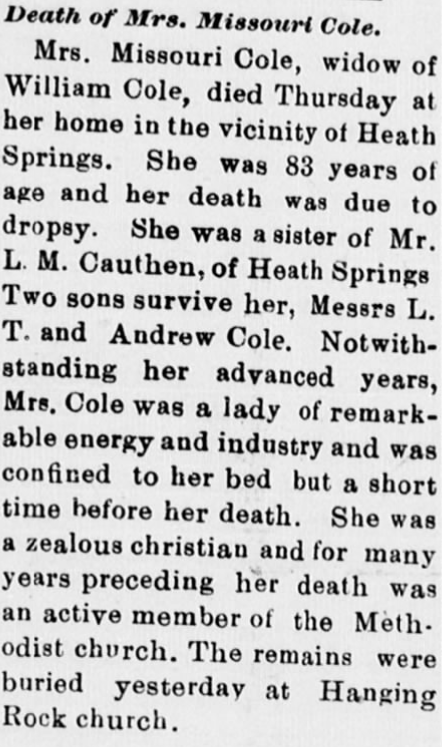
  28. Find a Grave, database and images (https://www.findagrave.com/memorial/86134658/alma-wilson: accessed August 8, 2025), memorial page for Alma Wilson (14 Apr 1896–22 May 1897), Find a Grave Memorial ID 86134658, citing Sharon United Methodist Church Cemetery, Abbeville County, South Carolina, USA; Maintained by Record Hunter (contributor 47130288). ↩︎
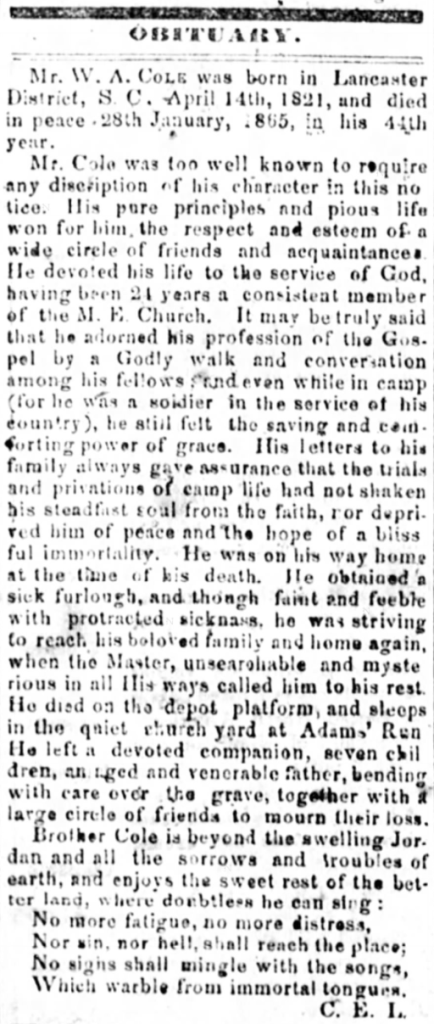
  29. The Abbeville Press and Banner, 8 Jun 1910 ↩︎
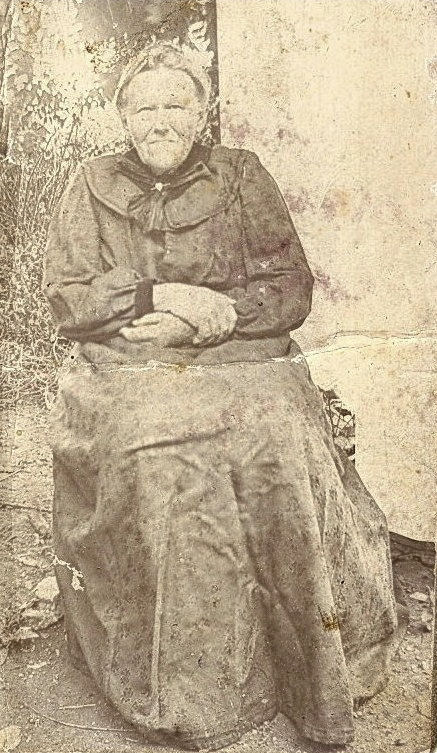
  30. Find a Grave, database and images (https://www.findagrave.com/memorial/22853509/james_a-wilson: accessed August 8, 2025), memorial page for James A. Wilson (9 Oct 1853–10 Nov 1914), Find a Grave Memorial ID 22853509, citing Sharon United Methodist Church Cemetery, Abbeville County, South Carolina, USA; Maintained by Jonathan Reeves (contributor 46928429). ↩︎
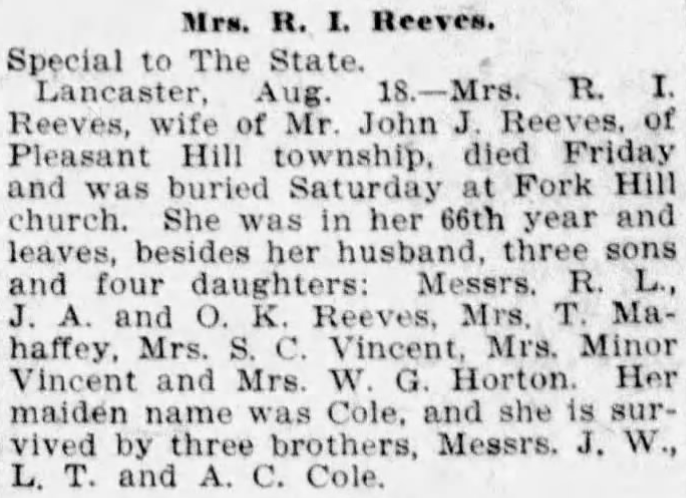
  31. “United States, Census, 1940”, FamilySearch (https://www.familysearch.org/ark:/61903/1:1:VTHC-5MR : Fri Mar 08 19:17:43 UTC 2024), Entry for James H Wilson and Della Wilson, 1940. ↩︎
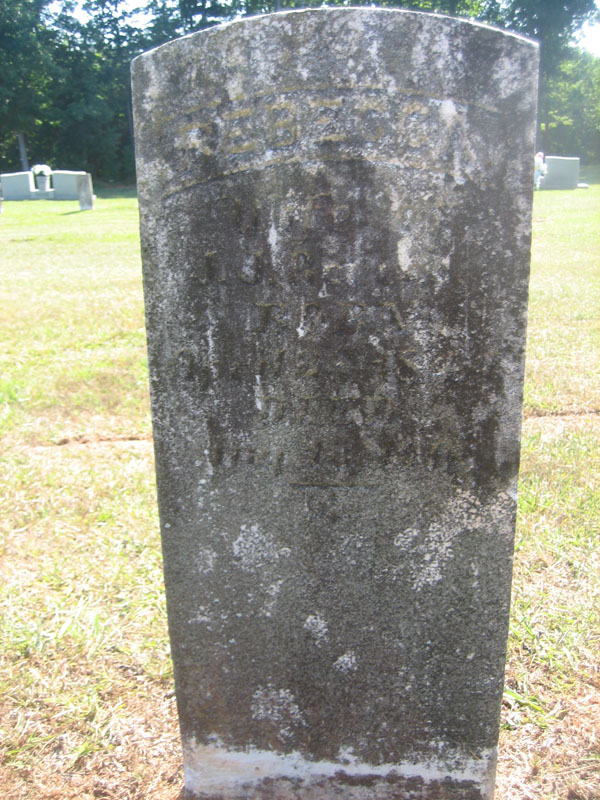
  32. “United States, World War I Draft Registration Cards, 1917-1918”, FamilySearch (https://www.familysearch.org/ark:/61903/1:1:W8G1-TFT2 : Thu Jul 24 12:46:26 UTC 2025), Entry for Laurence Franklin Wilson and Lula Pearl Wilson, 28 April 1918. ↩︎
  33. “United States, Census, 1910”, FamilySearch (https://www.familysearch.org/ark:/61903/1:1:M56X-BFS : Sun Mar 10 19:09:53 UTC 2024), Entry for Lawerence Wilson and Lula Wilson, 1910. ↩︎
  34. “United States, Census, 1920”, FamilySearch (https://www.familysearch.org/ark:/61903/1:1:M6ZH-BZX : Wed Jan 22 00:06:31 UTC 2025), Entry for L F Wilson and Lula Wilson, 1920. ↩︎
  35. “United States, Census, 1930”, FamilySearch (https://www.familysearch.org/ark:/61903/1:1:SPH8-GM3 : Sat Mar 09 16:34:48 UTC 2024), Entry for Larence F Wilson and Lula P Wilson, 1930. ↩︎
  36. “United States, Census, 1940”, FamilySearch (https://www.familysearch.org/ark:/61903/1:1:K48Q-NVG : Fri Jan 17 05:33:51 UTC 2025), Entry for Lawrence Wilson and Lula Wilson, 1940. ↩︎
  37. “United States, Census, 1950”, FamilySearch (https://www.familysearch.org/ark:/61903/1:1:6F7H-RMWB : Fri Oct 06 06:45:29 UTC 2023), Entry for Lawrence F Wilson and Luly C Wilson, 5 April 1950. ↩︎
  38. “McCormick County, South Carolina marriage licenses,1916-1950”, FamilySearch (https://www.familysearch.org/ark:/61903/3:1:3Q9M-C91X-WSWJ-6) ↩︎

Catoe

Unless otherwise noted, all of this information comes from notes made by Sarah Ola Crimminger Nettles and Buena Crimminger Feeney based on information related to them by their father Willie Crimminger, son of Mary Jane Catoe Crimminger.1,2

Mr. Catoe

Catoe (or Cato) is the surname chosen by (or for) an orphan boy who would later be the father of Mary Jane Catoe Crimminger. Given that he was the father of Mary Jane Cato(e) who was born in 1824, it’s likely that Mr. Cato was born around the 1790s. According to both tradition and the place of birth for her father given in the 1880 census entry for Mary Jane,3 Mr. Cato was from England.

The story, as related to Grandpa (Willie) Crimminger by his mother Mary Jane Cato(e) Crimminger, goes as follows: “As a very small boy, her father was lured aboard a boat coming to the United States from England and was brought eventually to the Camden District area. When asked his name, each time he replied only with ‘Cat,’ thus this was given him as a surname. He made his home with a family by the name of Thompson, and at a suitable age became an apprentice to Mr. Thompson as a saddlemaker. In later years he was married and his wife expected their first child, at which time his friends teased him severely, asking ‘when is your wife going to have her kitten?’ Being a sensitive person he became so incensed that he applied to the Legislature to have his named changed to ‘Cato.'”

Further notes from an interview of Grandpa Crimminger state that “He was abducted as a very small child by sailors from a wharf in England. They took him away from his nurse, put him on the ship and brought him to America. All he could say was “Cat”, so that is what he was called.” More sensational versions passed down the family claim he was abducted by pirates and brought to Charleston.

Grandpa Crimminger stated that his parents, Robert and Mary Jane, were first cousins. Their mothers were both daughters of Samuel Love.

Mr. Catoe’s wife was always in poor health. The family traveled for her health. Grandpa Crimminger related his mother’s memories of traveling as a child in a covered wagon through North Carolina, Tennessee, Missouri, and of seeing the Mississippi river. Mr. Cato would skin the bark off a pole and use it to catch prairie chickens. He would disturb the roost and they would fly or settle along the pole and slide into a sack on the other end. They eventually returned to the Camden area. Following Mrs. Catoe’s death, Mr. Cato returned to Tennessee, leaving Mary Jane with a family named Carpenter who were shroud makers. Mr. Cato remarried in Tennessee and Mary Jane eventually lost contact with him.

Mary Jane Catoe

Mary Jane Catoe was born 14 Feb 1824.4 When her father left for Tennessee after her mother’s death, Mary Jane stayed with a family named Carpenter who were shroud makers. Grandpa Crimminger related the story that one Saturday they had a shroud to finish by the next day. Midnight came and they had not finished. So they shut the windows and closed the shutters to keep out the light of Sunday and worked on until they finished. Mary Jane was a member at Salem Methodist Church, as were the Thompsons, the family her father had grown up with.

Mary Jane’s name appears in a list of letters left at the Camden post office in 1840.

Camden Journal, 18 Jan 1840

Grandpa Crimminger’s claim that Mary Jane and Robert were first cousins appears to be substantiated by an 1845 deed in which the children of Samuel Love and Mary Jane Cato sold some land together.5 This would imply that she was an heir of the Love family as well.

According to the Family Bible, she married Robert Crimminger on 3 Feb 1846.6 She had her fortune told before her marriage. The fortune teller told her she would marry a man who would always have plenty. She and Robert had ten children.

Robert and Mary Jane Crimminger

Mary Jane was sick for about the last ten or fifteen years of her life. Her doctor was Dr. Columbus Cauthen, whom she trusted greatly. He told her one day she would die the next day at twelve o-clock. But the next day, she took a turn for the better at precisely that time.

In contrast to her husband, Mary Jane was a very religious person who read and studied the Bible and taught it to her children.

Oscar and Mary Reeves stayed with Mary Jane for a brief period, apparently after Robert had passed. Later, she moved in with Grandpa (Willie) Crimminger. However, Grandpa Crimminger also reported that she died sitting in a chair in the south door of the second Love house, which was where Robert and Mary Jane had lived. The obituary reported she died at Grandpa Crimminger’s home. There seems to be some confusion on this point. After her death, Robert and Mary Jane’s home was burned down by some children who were playing in the fire and accidentally set the mantle cloth on fire.

The Lancaster News, 23 Jan 1904
  1. Crimminger Family Tree written by Sarah Ola Crimminger Nettles with help from Earle Reeves ↩︎
  2. Interview of Willie Crimminger by daughter Buena Crimminger Feeney with additional notes ↩︎
  3. “United States, Census, 1880”, FamilySearch (https://www.familysearch.org/ark:/61903/1:1:M6SJ-XXD : Sun Jan 19 02:55:14 UTC 2025), Entry for Robert A. Criminger and Mary J. Criminger, 1880. ↩︎
  4. Find a Grave, database and images (https://www.findagrave.com/memorial/75142100/mary_jane-crimminger: accessed June 30, 2025), memorial page for Mary Jane Catoe Crimminger (14 Feb 1824–18 Jan 1904), Find a Grave Memorial ID 75142100, citing Salem Cemetery, Heath Springs, Lancaster County, South Carolina, USA; Maintained by Boyce M. Lawton, III (contributor 47916517). ↩︎
  5. Lancaster County, SC Deed Book P, p94, FamilySearch (https://www.familysearch.org/ark:/61903/3:1:3Q9M-CSR8-NS6L-9?cat=472451&i=566) ↩︎
  6. DAR Supporting Documentation for Application of Ola Crimminger Nettles #659002, Patriot Frederick Grimminger #A048570 ↩︎