The Florio family was a rather famous Italian Renaissance family that moved from Florence area to Switzerland and then to England because of the Reformation. Many of the original sources on this family are hard to obtain or read as they are in Italian or Latin. A lengthy paper by Professor Carla Rossi, art historian, Romance philologist and palaeographer, entitled Italus ore, Anglus pectore: studi su John Florio (a combined Latin and Italian title which translates to Italian in mouth, English in heart: Studies on John Florio) provides some lengthy evaluation of various records on this family.1 Part of her motive was to correct some of the incorrect notions on this family, for example the popular but unsubstantiated claim that John Florio was the real Shakespeare.
Michelangelo Florio
Rossi establishes that Michelangelo was the author of three known printed works: an Apologia from 1557, a 1563 Italian translation of Georgius Agricola’s mining treatise De re metallica, and a 1607 (posthumous) biography of Lady Jane Grey. The Apologia includes various biographical details which help paint the bigger picture of his life. There is a famous quote in this which has been taken a variety of ways to affirm or deny Jewish ancestry. It’s very probable given that many Italians in that area of his day had Jewish ancestry that the Florios did as well, but the context of the statement reveals a less literal meaning to the debate. A Franciscan friar named Bernardino Spada had attacked him in a letter accusing him of having Jewish blood. This would be to imply that that his immediate family had been forcibly baptized into Catholicism. He refuted this at length. While Jewish ancestry is likely given his Italian context, he concerns himself with the spiritual accusations connected to it and completely denies this.
“I dwelt more than an hour fantasizing over these words of yours to draw them out, as they say in Florence, the marrow of it, and not being able to fully resolve what you mean to say, I will say only this for now: either you speak of carnal Hebraism, or of the spiritual kind that the Apostle Paul speaks of to the Romans. If you speak of the carnal, I doubt you haven’t drunk too much of the wine of Valtellina, which has turned your head, for I was never a Jew nor the son of a Jew, but rather of a father and mother baptized in the papist fashion, as you were. And if you were to say that my forebears, before baptism, had been Hebrews, this I will not deny — for who can deny that there are countless people descended from Jews or from pagans, which is far worse? And as for this, the Roman whore has not taken Hebraism from me, but rather God, who raises up children to Abraham even from stones, and has mercy on whom He pleases. But if you speak of spiritual Hebraism, this indeed I confess to you: that our Synagogue, condemned by Rome — outwardly only — drew me out of Hebraism; for by God’s mercy I was chosen to be a member of Jesus Christ, blessed seed of Israel, and to preach Him sincerely.”2
Michelangelo was originally a Franciscan Friar from the Florence area of Italy. He converted to Protestantism and worked as a pastor in England and Switzerland. He tutored Lady Jane Grey and also acted as a writer and translator. Concerning his leaving the Catholic faith, he states in the Apologia: “I tell you, then, that in the year 1550, on the 4th of May, I fled from Rome, and there in the house of a good and honored person I stayed one day and two nights. Then I departed on the 6th, two hours before daybreak, and by way of Abruzzo I made my way to Naples, having shed the friar’s habit; in Naples I stayed ten days among religious and Christian persons… until I was provided with what I needed to live and clothe myself, for many days and months.” Reflecting further, he also stated that he left the Catholic Church “with its superstitions and idolatries, kept me tangled for more than thirty-two years in its net of deceptions and errors.” Since those in the Catholic faith would have viewed themselves as being part of it from their baptism at birth, Rossi uses these statements to conclude that he was born around 1518, with thirty-two years of Catholic life before the 1550 flight from Rome.
Rossi then uses this date to trace down a baptismal record that she claims is for this same Michelangelo in the same work and also discusses it at length in another publication.3 The record is from the baptismal register of the Cathedral of Works, Florence, an entry from 28 Sep 1518 and translated reads: “Michelangelo and Romulo, of Master Giovanni, wool-carder, parish of San Benedetto. Born on the said day, at the 12th hour.” She explains that it was the custom to additionally give a child a second name based on the city’s founder (Romulo) as is seen in this record.

As already noted, Michelangelo converted to Protestantism. It seems that he ran into trouble in 1548, perhaps arrested. This is taken from a statement in the Apologia where he mentions “the outrages, the scorns, and the torments that in Rome, for the space of twenty-seven months, under Paul and Julius III, he had suffered, for having preached Christ unmasked in Rome, Naples, Padua, and Venice.” The twenty-seven months counts down to when he fled Rome, so it appears that Rome arrested him 1548. After Naples, he described going to Puglia (“where I stayed two months, well received and cared for by Christian brothers”), by sea to Venice (“I stayed seventeen days and spoke with two of your friars, whom I won’t name so as not to harm them”), then overland through Mantua, Brescia, Bergamo, Milan, Pavia, and Casale di Monferrato to Lyon, then Paris, reaching England on 1 Nov 1550.
Florio was tutor to Lady Jane Grey a few years after this. There survives a work which Florio wrote entitled Literature of Tuscany which includes a dedicatory letter written to her.4 The Memorials of the Most Reverend Father in God Thomas Cranmer reports that “About this time, viz. in the year 1550 or 1551, there was also a church of Italians constituted in London by the influence and care of our Archbishop and Sir William Cecyl, under A Lafeo’s superintendency…One Michael Angelo Florio, a Florentine by birth, was appointed their preacher.”5
There exists a letter from Michelangelo to one of his supporters, William Cecil, Secretary of State, who along with Thomas Cranmer had helped him obtain his position as the pastor of the Italian refugees. Cecil apparently was withdrawing his support due to some kind of impropriety. He writes to Cecil, acknowledging his faults and reminding him of God’s grace and seeks to have his support again. In particular, he states (as translated from the Latin) “I dare to exclaim to you in these letters of mine, and confess that you have not wrongly called me a criminal, because, with certain mists arising from the muddy concupiscence of my flesh, and clouding my heart, I fell through the precipices of desires, and fell headlong into the abyss, the abyss and the whirlpool of lust and impurity, forsaking God, whose wrath prevailed over me.”6 Thomas Cranmer wrote a letter to Cecil on 20 Nov 1552 about some correspondence with the Lord of Northumberland and mentions “I have written also unto hym in the favour of Michael Angelo; whose cause I pray you to helpe so moche as lieth in you.”7 Further context of the situation is revealed in a letter sent from Bishop Edmund Grindal of London to Jean Cousin, minister of the French Church dated 12 Oct 1568. Translating from Rossi’s quotation:8
Greetings. I ask that you have a brief summary of the proceedings transcribed for me concerning Michael Angelo the Florentine, who was removed from his ministry in the Italian Church here in London, in the reign of Edward VI of most blessed memory, on account of the violation of a maidservant, as it is reported. I believe that book of proceedings is in the keeping of Master Godfrey Wingius and the elders of the Flemish Church. Also describe for me, briefly, the form of the public penance that the same Michael underwent — but write these two things separately, on different sheets. I also wish that the same be signed as witnessed by three or four of your people, and that you see this matter dispatched as promptly as you conveniently can. It would also be best that whatever is done in this affair not be made public.
Farewell.
12 October 1568.
Yours in Christ,
Edmund of London
Rossi dates the letter written by Michelangelo to Cecil based on internal statements to 23 Jan 1551/2. John Florio, son of Michelangelo is calculated by Rossi to have been born Sep 1552. Together along with a couple other possible references to the affair, historians have come to the conclusion that Michelangelo fathered John through an affair with this maidservant referenced in the 1568 letter from Bishop Grindal. Rossi agrees with this. However, further details have been apparently added onto the story over time which Rossi contests. According to the 1889 Dictionary of National Biography entry, Michelangelo was living in the Cecil household and “was ultimately banished from Cecil’s house, where he had resided” after taking advantage of someone in the household. Later versions even claim she was a noblewoman. Rossi contests this, showing that Michelangelo actually lived elsewhere.
After King Edward VI died in July 1553, there was a controversy about the succession in which Protestants put forward Lady Jane Grey to keep a Protestant on the throne. This ultimately led to her death and the reign of Bloody Mary. The Florio family was forced to flee England and ultimately moved to Soglio, Switzerland where he arrived 27 May 1555 according to his Apologia. He became pastor there and was involved in a controversy where some accused him of sympathizing with anti-Trinitarians at the Synod of Chur held in 1561.
Michelangelo and his wife were apparently deceased by mid 1573. There is a deed Rossi discusses entitled “Designation to Constantia, daughter of Lord Michelangelo, by the representatives of the surviving children. 29 June.”9 in which a representative of “the heirs of the late Lord Michael Angelo Florio of Florence, formerly the faithful minister of the Word of God to the church of Soglio, gave and assigned to Lady Constantia, daughter of the aforesaid late Lord Michael, all the movable goods — that is, the linens, together with two gowns — which had belonged to the late Lord Michael or to his late wife, mother of the said heirs.” Rossi concludes he must have married the woman with whom he had the affair. Interestingly the deed refers to plural heirs and also states that his late wife was “mother of the said heirs” which lends support to this idea.
John (Giovanni) Florio
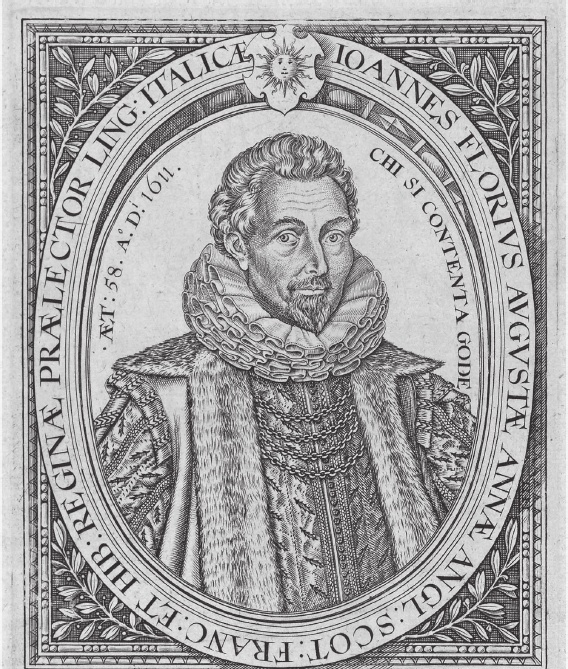
John Florio’s birth is not recorded in any surviving parish register. Carla Rossi reconstructs the date from two later documents instead: the engraved portrait in the front matter of his 1611 dictionary, Queen Anna’s New World of Words, which states the sitter’s age as 58, combined with the Stationers’ Register entry for that same dictionary, which she dates to February 1611 Old Style (1612 New Style). Counting back from age 58 in February 1611/12 places his birth in August or the very first days of September 1552. As discussed above, Rossi and most later historians connect this birth to the affair between Michelangelo Florio and an unnamed maidservant in the Cecil household — the same episode described in Bishop Grindal’s 1568 letter — which appears to have cost Michelangelo his London ministry around 1550–52. Not every source agrees on the year: Italy’s Dizionario Biografico degli Italiani states that when Michelangelo fled London on 4 March 1554 he was accompanied by “la moglie e il figlio Giovanni, nato l’anno precedente” — his wife and son Giovanni, born the previous year, i.e. 1553 — which is closer to the traditional birth year still given in many older biographies. Rossi’s more granular calculation from the portrait and Stationers’ Register entry is generally preferred by recent scholarship, but the discrepancy is worth noting for anyone reconciling the family’s various birth dates.10
As an infant not yet two years old, John crossed Europe with his parents when the family fled England on Mary I’s accession. Michelangelo’s own account in the Apologia states the family left London on 4 March 1554 and reached Strasbourg on 6 May 1555; Strasbourg’s own municipal archives independently confirm the family’s presence there, recording in a charitable distribution of 2 January 1555 that Michelangelo “hat weib und kind” — has a wife and child.11 The family reached Soglio, in the Val Bregaglia, on 27 May 1555, as described above, and John was raised there through his father’s pastorate. Rossi places him at the University of Tübingen by 1563, matriculated at about age ten or eleven; she draws the record from Hermelink’s printed edition of the university’s matriculation register, though the original manuscript register (Tübingen University Archives, shelfmark UAT 5/26, vol. 3, p. 58) has since been cited independently for the same entry, giving John’s age as eleven rather than ten.12 Michelangelo and his wife — John’s mother, still unnamed in any surviving record — were both dead by mid-1573, and probably by 1566 specifically: a Bernese correspondence of that year already refers to Michelangelo’s death, and a Soglio notary who would otherwise have witnessed later Florio family transactions himself died in 1571 without ever doing so.13 The 1573 deed already discussed above, distributing “the linens, together with two gowns” that had belonged to “the late Lord Michael or to his late wife, mother of the said heirs,” almost certainly counts John among its unnamed plural “heirs” — he would have been orphaned in his early-to-mid teens.
John Florio next appears, firmly datable, in a census of resident foreigners taken in London on 10 November 1571, which records a French silk-dyer, Michael Baynard, as having “two seruantes, Baptist Clarencye and John Floren, Italions, of the Italion church.”14 Working in Baynard’s dyeing trade, Florio married on 5 February 1574 at St James Garlickhithe, London; the parish’s rough-draft register gives the bride’s name as “an sore fello,” and the fair copy as “Anne Sore sollo” — Rossi reads this as an Italian surname ending “-sollo” or “-sello,” i.e. “Anna Soresollo,” rather than the English surname “Sore.”15 The couple had six children, baptized at three different parishes as the family moved, and only one of whom survived to adulthood:
- Annabelle (or Annable) Florence, baptized 1 April 1576 at St James Garlickhithe, her father recorded as “John Florence, dier.”16
- Anne Florence, baptized 22 September 1577, same parish.17
- Aurelia — recorded in the register as “Olrarie Floreus” — baptized 8 October 1578, same parish; the only one of the six to survive to adulthood, and the only child named in her father’s will.18
- Joane, baptized 14 September 1585 at St Peter le Bailey, Oxford, showing the family had relocated there by that date.19
- Edward, baptized 19 June 1588 at St Andrew Holborn, London, and buried there seven weeks later, on 8 August 1588.20
- Elizabeth (“Elsabothe”), baptized 18/19 June 1589, same parish.
Joane and Elizabeth both disappear from the record after their baptisms and are presumed to have died as children during the severe London plague years of 1592–94; only Aurelia lived to be named in her father’s 1625 will.
Florio’s career as a language teacher and writer began while he was still nominally a dyer — his own dedication to Firste Fruites (1578) states plainly that teaching Italian “non è la mia professione,” is not his profession.21 He was incorporated at Oxford around 1580 (a university register sometimes read instead as 1581, an apparent clerical slip).22 By 1583 he was attached to the French embassy in London, where he formed a close friendship with the philosopher Giordano Bruno.23 He published a second Italian-teaching dialogue and proverb collection, Second Frutes, in 1591, and his first Italian–English dictionary, A Worlde of Wordes, in 1598 — later expanded as Queen Anna’s New World of Words in 1611.24 In 1603 he published his best-known work, an English translation of Montaigne’s Essays, and around the same time entered royal service as a Groom of the Privy Chamber and Italian reader to Queen Anne of Denmark, a post he held for the rest of her life.25 A continually debunked claim made over the years has been that he was the actual author behind the Shakespeare works, but this has been soundly refuted by various historians.
Florio’s first wife, Anne, does not appear in any record after their last child’s 1589 baptism and was presumably long dead by his second marriage. On 9 September 1617, at St James Clerkenwell, “John Florio Esquire” married Rose Spicer.26

A long-standing legend held that this second wife was “Rose,” a sister of the poet Samuel Daniel, and even that she was the model for Shakespeare’s “Dark Lady” — an idea Rossi traces to the nineteenth-century clergyman Nicholas John Halpin and rejects outright as unsupported by any archival record. Rose Spicer, from a Kent gentry family, outlived Florio: she is recorded at Fulham in April 1626, recently widowed and too poor to pay the parish poor-rate, and was buried at Hythe, Kent, on 27 July 1631.27
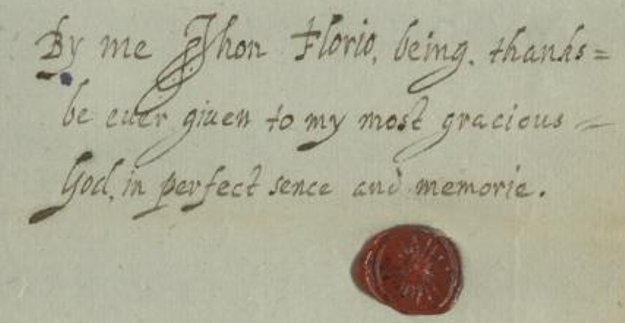
Florio wrote his will on 20 July 1625, describing himself as “of Fulham in the Countie of Middlesex, Gentleman.” He left Aurelia only “the wedding ring wherewith I maried her mother,” lamenting that poverty left him “not able to leave her anything els”; to James Molins he left a black velvet writing desk, embroidered with seed pearls, that had belonged to Queen Anne. The residue of the estate, along with his personal library of some 340 books, went to Rose — though the books, which he had asked to be sent to the Earl of Pembroke, never reached their intended destination; Rossi’s research suggests Rose instead sold part of the collection, including manuscripts of Florio family origin, to the lexicographer John Torriano. The named executors renounced execution of the will for reasons that were never recorded. Florio’s own autograph will survives at the National Archives, PROB 10/438, with a registered copy at PROB 11/149/289.28 It was proved in June 1626, meaning Florio died sometime between the will’s writing in July 1625 and its proving the following June — traditionally said to be of plague, at Fulham, in the autumn of 1625, though no burial record or surviving monument has been found.29
Aurelia Florio
No marriage record for Aurelia has been found, but she is identified securely as John Florio’s daughter both by his own will, which names “my daughter Aurelia” and “my sonne in law James Molins,” and independently by James Molins’s own 1638 will.30 She married James Molins (Mullens), a barber-surgeon of London, and raised a large family. Secondary literature credits Aurelia with becoming a noted London midwife, with helping examine ten Lancashire women accused of witchcraft on 2 July 1634 (the examination found no evidence supporting the accusations), and records her death “a rich widow” in London on 12 July 1641.31 She left a will dated 7 Feb 1640/1. She described herself as “Aurelia Molins widowe late wife of James Molins tholder cittizen & Barber Chirurgion of London deceased.” She named her children including “my daughter Aurelia Cox the wife of William Cox” to whom she gave five pounds.32 She was buried at St. Andrew, Holborn on the 13th, the entry also noting her death on the 12th at the house of Will “Monllins.”33

- Rossi, Carla. Italus ore, Anglus pectore: studi su John Florio. Vol. 1. Studies & Essays 2. London: Thecla Academic Press, 2018. ↩︎
- Florio, Michelangelo. Apologia, p34 ↩︎
- Rossi, Carla. “La fede di battesimo di Michelangelo Florio, nato a Firenze, addì 28 settembre 1518 a hore 12.” Theory and Criticism of Literature and Arts (TCLA), vol. 2, no. 1 (November 2017): 96–115. ↩︎
- Sloane MS 3011, British Library, https://searcharchives.bl.uk/catalog/040-002115395 ↩︎
- Strype, John. Memorials of the Most Reverend Father in God Thomas Cranmer, Sometime Lord Archbishop of Canterbury. New ed., with additions. Vol. 1. Oxford: Clarendon Press, 1812. Internet Archive. ↩︎
- Strype, John. Memorials of the Most Reverend Father in God Thomas Cranmer, Sometime Lord Archbishop of Canterbury. New edition, with additions. Vol. 2. Oxford: At the Clarendon Press, 1812. Appendix, Records, no. LIII, p. 883. ↩︎
- Strype, John. Memorials of the Most Reverend Father in God Thomas Cranmer, Sometime Lord Archbishop of Canterbury. New edition, with additions. Vol. 2. Oxford: At the Clarendon Press, 1812. Appendix, Records, no. CVII, p. 1036. ↩︎
- Rossi cites British Library, London, Lansdowne MS XLV, no. 29, fol. 65–66 ↩︎
- Staatsarchiv Graubünden (Chur), Codice/Protocol B 663/27, fol. 48 (full text of the act), with the filing/index notation at fol. 10v. Notarized by Johannes Ruinella (Giovanni Ruinelli), notary of Soglio/Val Bregaglia. ↩︎
- Perini, Giovanna. “Florio, Michelangelo.” Dizionario Biografico degli Italiani, vol. 48 (1997), Istituto della Enciclopedia Italiana (Treccani). treccani.it ↩︎
- Florio, Michelangelo. Apologia (1557), pp. 108–112; Archives de la ville et de l’Eurométropole de Strasbourg, collection 1 R – Conseil des XXI – Procès-verbaux, 1 R 17, fol. 269v, and Procès-verbaux 1554–1555 (old shelfmark AA 638), fol. 410v (quoted in Rossi 2018, pp. 71–74). ↩︎
- Rossi 2018, pp. 150, 153, 155–156, citing H. Hermelink, Die Matrikeln der Universität Tübingen 1477–1817, Stuttgart, 1906, p. 434, no. 159.9; cf. Eberhard Karls University of Tübingen Archives, shelfmark UAT 5/26, vol. 3 (1545–1564), p. 58. ↩︎
- Burgerbibliothek Bern, ms. A.93.II (Torriani correspondence); Rossi 2018, p. 159, citing also Lentolo’s Commentarii and the record of the Soglio notary Nicola Mora’s death, May 1571. ↩︎
- Returns of Aliens Dwelling in the City and Suburbs of London from the Reign of Henry VIII to that of James I, Huguenot Society Proceedings, vol. X, part II, 1902, p. 124; cf. UK National Archives, Kew, S.P. 12/82, fol. 104, State Papers Domestic, Elizabeth I, 1571 (Rossi 2018, p. 162). ↩︎
- London Metropolitan Archives, St James Garlickhithe, Composite register 1535–1621, P69/JS2/A/001/MS09138, fol. 44, and Composite register: baptisms and burials 1535–1693, marriages 1535–1692, P69/JS2/A/002/MS09140 (Rossi 2018, pp. 208–210, 175). ↩︎
- London Metropolitan Archives, St James Garlickhithe, P69/JS2/A/001/MS09138, fol. 47 (Rossi 2018, pp. 175–176). ↩︎
- London Metropolitan Archives, St James Garlickhithe, P69/JS2/A/001/MS09138, fol. 51 (Rossi 2018, p. 176). ↩︎
- London Metropolitan Archives, St James Garlickhithe, P69/JS2/A/001/MS09138, fol. 56, and P69/JS2/A/002/MS09140 (Rossi 2018, pp. 176, 178). ↩︎
- Register of St Peter in the Baylie, Oxford (Rossi 2018, p. 218). ↩︎
- London Metropolitan Archives, St Andrew Holborn, Register of Baptisms 1558–1623, P82/AND2/A/001/MS06667, and Register of Burials, P69/AND2/A/010/MS06673 (Rossi 2018, pp. 219–220). ↩︎
- Florio, John. Firste Fruites, London, 1578, dedication (Rossi 2018, p. 182). ↩︎
- Rossi 2018, pp. 214, 216–217, citing A. Clark, ed., Register of the University of Oxford, vol. II, pt. I (Oxford Historical Society, 1887), p. 392. ↩︎
- Rossi 2018, pp. 221–230; Public Record Office, S.P. 78.14, nos. 84–85, ff. 186–187. ↩︎
- Florio, John. Florios Second Frutes, London, 1591; A Worlde of Wordes, London, 1598; Queen Anna’s New World of Words, London, 1611. ↩︎
- Rossi 2018, p. 252; licensing entry of 4 June 1600 to Edward Blount, Stationers’ Register. ↩︎
- London Metropolitan Archives, St James Clerkenwell, Composite register, P76/JS1/004 (Rossi 2018, pp. 212–213). ↩︎
- Rossi 2018, pp. 206–208, citing A. Burl, Shakespeare’s Mistress, Amberley Publishing, Stroud, 2012; Hythe Library, Parish Records, St Leonard, Burials 1586–1920, ref. KFHS-2223. ↩︎
- The National Archives, PROB 10/438, PROB 11/149/289 (Rossi 2018, pp. 266–284). ↩︎
- Anthony à Wood, Athenae Oxonienses, ed. P. Bliss, Oxford, 1813, vol. II, p. 269; Rossi 2018, pp. 266–267. ↩︎
- Prerogative Court of Canterbury Piece 178 (Lee), folio 478 reverse ↩︎
- G. Morris, “Molins, James,” Oxford Dictionary of National Biography, 2004; John Carey, Eyewitness to Science, Harvard University Press, 1995, pp. 21–22. ↩︎
- London Metropolitan Archives, MS 9052/10; Will Number: 212 ↩︎
- London Metropolitan Archives, St. Andrew, Holborn, Composite register, 1623-1642, P69/AND2/A/010/MS06673/002 ↩︎